Showing posts with label students. Show all posts

Saturday, April 13, 2019

Seminar on Disaster Risk Reduction and Infrastructure Development


CIV680 is a graduate seminar on Disaster Risk Reduction and Infrastructure Development (DRRID) in the graduate program for Civil Engineering. The course presents the impact of natural hazards on the built environment and explores ways of reducing the adverse effects of the natural hazards and improving infrastructure and community resilience. The topics that are discussed include disaster and development, natural hazards (earthquakes, volcanoes, wind, flood), risk, vulnerability, risk assessment, hazard analysis, disaster risk reduction (DRR), infrastructure resilience and climate change adaptation (CCA).  The primary objective of the course is "to develop champions and advocates for DRR, CCA and Disaster Resilience." The course aims to integrate civil engineering to the broader problem on DRR, CCA and Resilience Building.

I introduced this course in 2014. In this, I invited faculty members in the college to deliver lectures on specialized topics related to DRRID. This term 2 AY2018-2019, I wish to express my gratitude to the following faculty members:
  1. Dr. Lessandro Garciano - Wind Hazards 
  2. Dr. Renan Tanhueco - Flood Hazards and Land Use Planning
  3. Dr. Mario De Leon - Tsunami, Storm Surge and Coastal Communities
  4. Dr. Jonathan Dungca - Geotechnical Hazards 
  5. Dr. Maricel Paringit - GIS and Mapping in DRRM
  6. Dr. Jojo Mutuc - System Dynamics and DRR
The culminating activity of the course is the DRRID Graduate Forum held last April 6, 2019 at DLSU Velasco Hall from 1:00 PM - 6:30 PM. In this activity, each student presents his/her seminar paper related to the theme of the course. 

The guest speaker in the forum was Dr. Emmanuel Luna, Professor in Community Development at UP Diliman and a director of the UP Resilience Institute. His presentation was on "Recovery of Infrastructures from Disasters: Lessons from Philippine Cases."
Dr. Luna presents his lecture  on Recovery of Infrastructures from Disasters: Lessons from Philippine Cases
The DRRID2019 Forum followed the program below:

Session 1 Opening Program - Emcee: Engr. Robert R. Dancel 
  •       Opening Prayer       – Engr. Angelica P. Saludo
  •       Welcome Message   – Dr. Andres Oreta (Professor, DLSU)
  •       Keynote Speech: Recovery of Infrastructures from Disasters: Lessons from Philippine Cases - Dr. Emmanuel M. Luna (Prof, UP Resilience Institute)

Session 2 DRRID Session 1 – Session Chair: Engr. Jon Arnel Telan
  • P1: Guidelines for Development of Contingency Plan for Stranded Workers During Sudden Urban Disaster - Revin Berces
  • P2: 3D Printed House for Disaster Affected Areas - Robert R. Dancel
  • P3: Evaluating the site suitability of evacuation centers against natural hazards using GIS - Aujhen De Torres
  • P4: Seismic Risk Assessment of Metro Manila Bridges  - Eden S. Ditchella
  • P5: Fire Risk And Hazard Assessment Of Heritage Building: Case Of University Of Santo Tomas, Main Building - John Emmanuel C. Endaya
Session 3 DRRID Session 2 – Session Chair: Engr. Aujhen De Torres
  •  P6: Assessment of Disaster Awareness & Preparedness of Selected Barangays in San Juan City - Marc Daniel D. Laurina
  •  P7: Seismic Risk Assesment of Military Facilities: Case study of Fort Magsaysay - Albert Pamonag
  •  P8: Earthquake Vulnerability Assessment of Medical Facilities Inside the University of Santo Tomas Campus - Angelica P. Saludo
  • P9: Hazard Identification and Risk Assessment of Century Old Churches in Pampanga - Rejoice Marie P. Sambo
  • P10: Liquefaction Potential Assessment of Areas near Specific Creeks in Manila - Jon Arnel S. Telan 


Robert Dancel, PhD student and the chair of the forum presents a certificate of appreciation to Dr. Luna

The DRRID2019 Forum pamphlet with the abstracts of the seminar papers
 A best presentation was selected by Dr. Luna and Engr. Jon Arnel Telan was the selected the best presentor.

Sunday, June 9, 2013

Greener Designs of Buildings using the Structural Sustainability Index

Sustainability is a concern that must also be addressed by structural engineers. Structural engineers must be able to discriminate as to which materials and processes would have a lesser impact to the environment, and to coordinate with the other stakeholders of the structure. The concept of the study is to enable the structural engineer to analyse the sustainability of structural systems in a quantifiable manner. 

In designing a house, or any structure, there are three things commonly considered by the structural engineer. Namely: safety, serviceability and cost. Safety and serviceability ensure that the structure can fulfill its intended purpose by satisfying code requirements on strength, ductility and deflections. Addressing economy, on the other hand, requires value engineering to produce an optimum design with reasonable cost. There is now an increasing concern about the environmental impact of structures. Sustainable design of houses must be pursued to address this concern. But what parameter may be used to guide structural designers to make their structures “greener”?

In an undergraduate thesis, the environmental impact of the structural systems and envelope of selected housing units for a middle class family in the Philippines using Life Cycle Analysis (LCA) was conducted.  The five environmental impact parameters: (a) Global Warming Potential, (b) Ocean Acidification, (c) Abiotic Material Depletion, (d) Energy Use, (e) Human Toxicity were assessed considering the manufacturing and disposal stage as the system boundary in the LCA study. A  “Structural Sustainability Index” or SSI which produces a single score aggregating the five impacts was derived by assigning weights based on an expert’s survey for each environmental impact indicator. The SSI can be used for ranking houses based on environmental impact and can be used as a parameter to guide structural engineers in comparing various design alternatives and selecting  “greener designs”.

The image below is a poster submitted to the ASEP Student Research Competition during the 16th ASEP International Conference held on May 23-25, 2013.


Sunday, September 16, 2012

Open Ended Problems in Mechanics of Materials


Problem solving is one learning activity that is extensively employed by engineering educators. “Problem-solving is defined as a process used to obtain a best answer to an unknown or a decision subject to some constraints” (Mourtos 2004). Through problem solving students learn to apply the theoretical equations in both hypothetical and real-world scenarios. Assigning problem sets provides students the opportunity to test their understanding of the theory and concepts. The type of problems assigned to students addresses various levels of thinking and outcomes. Traditionally, problems are designed with given parameters and students are required to determine an unknown quantity. The solution usually involves substitution of known values to an equation to solve for the unknown parameter. Problems of this type are said to be “close-ended.” Close-ended questions usually have a unique answer and the procedure of obtaining the answer is limited or straight-forward. Close-ended problems address lower levels of thinking (based on Bloom’s taxonomy) like “remembering”, “understanding” and “applying” and some higher mode of thinking like “analyzing”.

To address higher levels of thinking like “evaluating” and “creating” and transformative outcomes experienced in the real-world, “open-ended” questions should also be included in the problem sets. Sobek and Jain (2004) emphasized the need for open-ended problems. “Employers look for engineers who are effective at solving open-ended problems. Engineering accreditation demands evidence that students can tackle open-ended problems proficiently.” Open-ended problems address considerably the student outcomes on “an ability to recognize, formulate, and solve civil engineering problems” and “an ability to engage in lifelong learning.” Open-ended questions are usually ill-defined and there may be more than one valid approach to obtain the solution. As a matter of fact, the solution may not be unique because of varying assumptions made regarding some parameters. Mourtos (2004) noted in their study that “traditional exercises (close-ended) found in most engineering texts, although useful, do not adequately prepare engineering students for real-world problems. Students seem to have great difficulty approaching these (open-ended) problems; however, they also seem to enjoy the challenge and perform reasonably well if given proper guidance.”

Problem : If you were to install a
steel Z-purlin, which arrangement
would you choose to maximize the
moment capacity of the section?

In the problem sets in my structural analysis course, open-ended problems are given. The problem shown about a Z-purlin is related to analysis of beams due to unsymmetrical bending which is similar to a problem by Singer. Deciding on the most effective set-up of the Z-section whether upright or inverted would require application of concepts in moment of inertia, equilibrium, bending moment and elastic bending stress analysis. There are various ways of determining the more efficient arrangement of the Z-section. You may compute which arrangment has the larger moment capacity. You can assume a moment and compute the maximum stresses and compare.

References:

Mourtos, N. et al. (2004). “Open-ended problem solving skills in thermal-fluids engineering,” Global Journal of Egg Education, UICEE

Sobek, D and Jain V. (2004). “The Engineering Problem Solving Process: Good for Students?” Proc.2004 American Society for Engineering Education (ASEE) Annual Conference & Exposition

NOTE: An updated version of this article - "Challenging Students' Thinking Through Open-ended Problems" was published as e-notes in The Philippine Engineering Education (Vol. 1, No. 1, Sept 2013) - the official news magazine of the Philippines Association for Technological Education (PATE).

Thursday, August 30, 2012

What is a soft story?

One of the requirements in my undergraduate course (STEQUAK) at DLSU is a group research related to earthquake engineering. The group has to present their topic orally using multimedia - powerpoint slides and a short video. The group of Gian Panaligan, Jerome Sy, Jospeh Oropel and Janelle Ong created a video about their topic, "How can we improve the seismic performance of a building with a soft story?" The language used is Filipino and their acting is very natural. A good story about a "soft story." Watch and enjoy.


Our last meeting - STEQUAK (Earthquake Engg) Class
8/30/2012

Monday, March 12, 2012

Model Popsicle-Stick Bridges of the Bridges in Asia


Chaotianmen Bridge (China)

In the recent Civil Engineering Society Bridge Building Contest, students from various civil engineering schools in Metro Manila were challenged to create popsicle stick bridges based on a segment of an actual bridge that can be found in the Asian region. The judging of the bridges took place last March 10, 2012 at the De La Salle University, Manila. It was a marvel to see the creativity of the students. There were model bridges that were really awesome and created meticulously following the photo of the actual bridge. The winner for the best design was the model of the Chaotianmen Bridge (China) submitted by the students from TIP. Marvel at the popsicle stick bridges below.

Asahibashi Bridge (Japan)


Asahibashi Bridge (Japan)


Ayala Bridge (Manila, Phils)

Zhejiang Road Bridge (China)

Merdeka Bridge (Malaysia)

Minamikawa Bridge (Japan)
Wanxian Bridge (China)

Quezon Bridge (Manila, Phils)


Dhamra Bridge (India)
Best Bridge Design

Thursday, July 21, 2011

How strong is "good lumber" in compression?

Compression Failure of a short timber column

To check the safety and serviceability of wood used as columns, posts and truss members, the compressive strength of the wooden elements must be known. "Good lumber" which is available in the Philippines are usually used but their properties ae unknown. Hence, this research was conducted.

Mechanical Properties in Compression of  Commercially Available Lumber in Metro Manila
 by
Liang Ta Chen, Francis F. Ebanos and Mark Justin K. Kung


Lumber in particular vary in strength depending on different parameters such as specie, dry density, slope of grain and others. Stress grading is used to be able to use lumber’s mechanical properties. However, many lumberyards do not have stress grading for the lumber they sell. In the survey conducted by the group on lumberyards in Metro Manila, Philippines, 81% of these lumberyards have little awareness or knowledge on what kind of wood they are selling wherein they do not know the specie of the lumber they were selling or the specie of their lumber was known but were mixed and could not be identified. The common species of these so-called “good lumber” were tangile, lauan, miranthe and saba while its source are almost half imported and half local.

This research aims to determine the mechanical properties in compression of commercially available lumber used as a structural member commonly referred to as "good lumber" in Metro Manila, Philippines. Compression members are usually used as post or truss members in roof trusses. 

Lumber that were tested had varying properties. The moisture content value of good lumber ranged from 11% to 62 % while the density ranged from 319 to 729 kg/m3. The compressive strength and modulus of elasticity of “good lumber” had high coefficient of variance which means it is very distributed. Compressive strength ranged from 3.996 to 51.386 MPa while modulus of elasticity ranged from 816.4 to 7921.3 MPa. The allowable compressive strength when ASTM D6570 is imposed is 7.372 MPa which is similar to the specie Malugai of the medium strength group with 63 % stress grade in the NSCP having an allowable compressive strength of 7.35 Mpa. On the other hand, the  modulus of elasticity when ASTM D6570 is imposed is 3510 MPa which is similar to the specie Bayok of the moderately low strength group with 63 % stress grade in the NSCP having an allowable modulus of elasticity of 3740 MPa. Tests of long columns also showed that Equation from Section 617 of NSCP holds true and showed that the values computed are much smaller than the actual failure stresses. The mechanical properties of  compression members obtained from this study may guide structural designers in their design computations.
Buckling of a long timber column

Monday, July 11, 2011

Good Lumber: How "good" are you as a structural beam?


Many low cost houses used wood as structural beams for joists in floor framing systems and for purlins in roof truss systems. When you design a beam, you must know the allowable strength properties for shear and flexure and the moduus of elasticity to check whether safety and serviceability requirements are satisfied. But when you buy wood in lumberyards in the Philippines, the wood specie is not usually known. The lumberyards simply label wood used as structural members as "good lumber" and obviously the strength properties are unknown. To address this problem of a civil engineer, the following research was conducted by DLSU undergraduate students. Here is the abstract of the thesis. A paper will be presented soon in conferences in the Philippines.


Mechanical Properties on Flexure and Shear of Commercially Available Timber Beams in the Philippines
by
Earl Marvin B. De Guzman, Michael Stephen C. Go, Katrina C. Tengki


Commercially available wood used as structural members are commonly referred to as “good lumber.” Good lumber consists mostly of imported lumber, and those of lesser known or unknown local species. With the wood species not clearly specified, there is a need to determine the mechanical properties of good lumber.

This study aims to determine the variation of strength properties of timber beams classified as good lumber. Standard laboratory tests were conducted to determine the range of values of the properties of good lumber such as moisture content, specific gravity, modulus of elasticity and the bending and shear strength of timber beams. The mechanical properties of good lumber were obtained through a series of laboratory tests that simulate the conditions for the loading schemes specified in the ASTM manual, on beams of nominal cross section 2”x4”. The laboratory tests results showed that good lumber has a moisture content ranging from 12-82% with 25% as average value, a relative density ranging from 0.236-0.743, and an average modulus of elasticity of 8.15GPa. The modulus of rupture ranged from 5.7 to 63.5MPa, while the shear stress at failure ranged from 0.60 to 4.15MPa. For structural design purposes, a reduction factor of 2.1 based on ASTM Standards was applied and the allowable flexural strength obtained falls within the range 11.0-18.0MPa, while the allowable shear strength obtained is within 0.77 to 1.34MPa. Comparing the strength properties to the timber species in the NSCP 2001/2010, it was found that good lumber in general would have values within the ranges for medium and moderately low strength group for 63% stress grades. With the information on the variation of strengths of good lumber obtained from the study, structural designers would be guided on appropriate allowable stresses to be used in the design of structural members made of wood such as purlins and joists.
The student researchers, Go, Tengki & De Guzman received certificates for being a finalist for the 2011 Gold Thesis Award for the Structural Engineering Division

Saturday, July 9, 2011

An Optimum Mix Design of High Strength Concrete using Genetic Algorithms

High-strength concrete (HSC) is a highly complex and evolving construction material. Careful selection of constituent materials must be employed to successfully proportion HSC mixtures. A guide for proportioning HSC by the American Concrete Institute (ACI) is available but the guide provides only a general idea of the proportions of the various components for HSC production. Presently, batching companies produce different trial mixes using the ACI guide and some trial and error considering the observed effect of each constituent material to the strength development of HSC in order to attain a target concrete strength. This method, however, requires plenty of mix design experimentation that is costly and time consuming. Through the years, trial mixes of HSC of various strengths have been compiled by batching companies. These trial mix data may be useful in deriving optimum mix designs of HSC.

This study explored the use of genetic algorithms (GA) in deriving optimum mix designs for HSC using data collected from a batching company. Three hundred ninety-six (396) HSC trial mixtures were analyzed to derive empirical equations for strength and slump which were adapted as GA fitness functions. The GA program generated optimum preliminary designs for concrete strengths in the range of 7,000 psi (48 MPA) to 10,000 psi (69 MPa) depending on the type of sand and whether silica fume is present or not. In-situ adjustments for the dosage of admixture and amount of water were applied to the GA preliminary mix designs to account for the moisture content and absorption of the aggregates. These mix designs were verified by implementing the mixture with in-situ adjustments and testing the concrete cylinders for compressive strength. The target values for strength and slump were obtained. Cost comparison also showed that the GA-HSC mix designs yielded lower material cost than the mix designs provided by the company indicating a near optimal and more economical mix design.
This is the undergraduate thesis of Iris Mae M. Malabatuan, Bertrand B. Teodosio and Analyn C. Yee Concepcion at Department of Civil Engineering, De La Salle University, Manila. CE faculty, Engr. Alden Paul Balili, who also completed his MSCE thesis on GA with application to RC Frames was a co-adviser of the group and his GA program was used in the thesis. The thesis group is a finalist for the 2011 Gold Thesis Award for the Structural Engineering Division.

ACKNOWLEDGEMENT:
The group members and the advisers wish to express their gratitude to D. M. Consunji, Inc. and its current president, Mr. Jorge A. Consunji, for granting the request to obtain concrete mix design data.

Friday, April 8, 2011

Oreta TIMBER Awards 2011

At the end of the school term,  I recognize the perfromance of the students in accomplishing the requirements in our Timber Design and Laboratory class through what I dubbed as the "ORETA TIMBER AWARDS." The requirements in the laboratory course are: (1) A Field Visit to a Lumber Yard, Construction Site or Timber Structures, (2) A Field Visit to the Annual WolrdBEX, (3) Design of a Wood Floor Framing System, (4) Design of a Wood Roof Framing System, and (5) Research on a Topic Related to Wood. There is actualy no prize just a recognition. This year's awardees are:
In my Timber Design Lecture, the students are tested on their understanding of concepts, equations and code specifications on wood design through quizzes and exams. A student who excels in the exams is usually named as "Most Promising Structural Engineer." This year, Bertrand Teodosio gets the award specifically for getting a perfect score in the final exam including the bonus problem. He is Mr. 110%. Still Bertrand had to work harder - be more assertive - to realize that promise.

Sunday, March 20, 2011

Amazing Popsicle-Stick Bridges 2011

Slide Album: Popsicle Stick Bridges
Here is a slide show of the popsicle stick bridges that were submitted to the 7th Bridge Building Competition organized by the Civil Engineering Society at De La Salle University - Manila, Philippines. Thirty-three entries competed for the Strongest Bridge, Stiffness Champion and Best Design (Aesthetics).
Congratulation to the winners:
Strength Category: Winner - Bridge 21 (PLM)
Stiffness Category: Champion - Bridge 21 (PLM)
Stiffness Category: Runner-up - Bridge 22 (PLM)
Aesthetic Design Category: Winner - Bridge 20 (TIP)

Saturday, March 19, 2011

7th Bridge Building Contest - Best in Aesthetic Design

The winning bridge from the TIP Team

The 7th Popsicle-Stick Bridge Building Contest organized by the Civil Engineering Society of De La Salle University was held on March 19, 2011. One of the highlights of the contest was the judging of the bridges based on aesthetic design. The criteria includes originality, innovativeness, craftmanship and practicality. The judges were lead by Engr. Mario Lualhati (PICE-LNM President), Dr. Amelia Marquez (PICE-LNM Secretary) and Engr. Mike Baylon (DLSU Alumnus and FEU-East Asia College faculty). Technological Institute of the Philippines (TIP) won the aesthetic design category out of the 33 brige entries. Marvelous!


Tuesday, November 16, 2010

Simple Beam Deflections


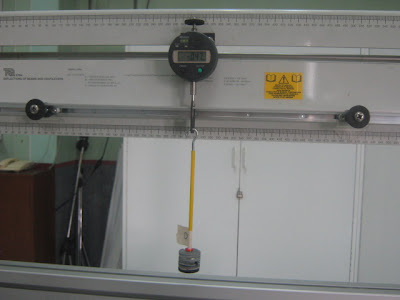
The STR4 assembly is aimed to investigate and visualize the deflection of simple beams and cantilevers. In this experiment, hanger and masses are applied on the beam and the deflection at a specific point of the beam is measured by a transducer and displayed on a digital dial test indicator.

One experment that we conducted using the STR4 was on simple beam deflections. Specifically, this experiment aims:
  • To determine the maximum deflection of a simple beam with length, L, due to a concentrated load P with varying magnitude applied at mid span.
  • To find the relationship between the maximum deflection and a point loading, P, applied at mid span.
  • To compare the maximum deflections of two types of beams with different materials and cross-section properties and determine the effect of these properties on beam deflection.

Each group was assigned a specific length of the beam and two types of materials to test. There were three types of materials available for testing: Aluminum. Brass and Steel.

The maximum or midspan deflection were measured for varying midpsan load. Graphs showing both the experimental and theoretical deflections were drawn and compared. The figures below show a comparison of the deflections for the three types of materials. The steel beam has the least deflection while the Aluminum beam has the largest deflection. The theory of elastic deflection of beams was confirmed through the experiment.


Monday, October 25, 2010

Theory of Structures Laboratory - Moment in a Beam

A new laboratory course in Theory of Structures was introduced in the DLSU BSCE curriculum. In this course, students perform laboratory experiments using TecQuipment Strucures Apparatus to investigate the behavior of simple structural members.
The first equipment used was the STR2 Moment in a Beam Apparatus. In this experimental set-up, hanger and masses are applied at specific points of the beam. There is a “cut” on the beam where the bending moment can be computed by measuring the force sensor (F) with a moment arm d from the cut. The experimental moment is equal to F times d.
The students performed two experiments using STR2. Expt. No. 1 investigated the relationship of the Moment with varying point load. A point load with increasing magnitude was applied on the beam and the Moment at a "cut" was observed. In Expt No. 2, the students observed the Moment at the "cut" when a moving load with constant magnitude was applied on the beam. They were able to derive an experimental influence line and compared with the theory.

Friday, April 30, 2010

Recognizing Students' Outstanding Performance in Timber Design


The term has just ended at DLSU. To inspire my students who will soon graduate and become civil engineers, I presented recognition awards which I named Timber Awards in my class in Timber Design. The awardees were:
  • Jonathan Salumbides (Molave Structural Engineer Award) for outstanding analytical skills in Timber Design Exams and Quizzes
  • Jet Tugado and El Rey Morales (Yakal Structural Design Award) for outstanding design projects in the Timber Design Laboratory
  • Ammer Ali, Nieman Mayo and Aizel Llanes (Narra Group Research Award) for outstanding field and library research projects and teamwork

I presented a simple memento - a ceramic coaster - which they can display or use while they drink coffee while working as a civil engineer. Congratulations and hoping for a bright future.

Monday, February 22, 2010

Best Bridge Designs at the 2010 Contest

The De La Salle University Civil Engineering Society (CES) hosted the Popsicle Stick Bridge Building Contest 2010. The bridge entries were judged last Feb. 13, 2010. There were 31 entries from various schools: DLSU, TIP-Manila, PLM, FEATI, DHVTSU, Mapua and FEU-EAC. In the Design Category, the bridges were judged based on the following criteria:
  • Creativity and Innovativeness in the design and form: 30%

  • Application of bridge design principles: 30%

  • Practicality and implementability: 20%

  • Neat and well-polished bridge: 20%

There is only one winner in the design category which was the entry from the Technological Institute of the Philippines - Manila. The other entries which ranked 2nd and third came from PLM and TIP-Manila, respectively.

Tuesday, January 19, 2010

Are you ready for the Struct-Whiz Challenge?


Who will be this year's ASEP Struct-Whiz Champion? Will there be a Struct Wizard among the participants of the 4th ASEP Struct-Whiz Challenge? The champions of the past 3 competitions came from UPLB, DLSU-Manila and TIP-QC. Whose school will reign supreme in the 2010 edition?

The Association of Structural Engineers of the Philippines (ASEP) is inviting undergraduate civil engineering students to join the 4th Struct-Whiz Challenge to be held on Feb. 19, 2010 at the NIA Conference Hall, EDSA, QC.

The topics of the quiz contest are Engineering Mechanics, Strength of Materials, Theory of Structures, Structural Design (Concrete, Steel, Timber), Design Codes(NSCP2001), Soil Mechanics & Foundation Design and Miscellaneous topics (e.g. Wind and Earthquake Loads, Principles of Bridge Design). Round 1 is written exam open to all participants. The top 20 examinees will qualify to Round 2 and 3.
The prizes are: P12,000 (1st), P8,000 (2nd) and P5,000 (3rd). Any participant who meets the cut-off score in rounds 2 & 3 for Struct Wizards will receive a special prize.

Wednesday, January 13, 2010

Popsicle Truss Bridge Building Contest 2010

The Civil Engineering Society of De La Salle University-Manila is again inviting civil engineering students from Philippine CE schools to join the Bridge Building Contest. The challenge is to create a popsicle truss bridge which will span a given distance subject to the bridge specifications or limitations in weight, heigth, width and length. The rules can be viewed in the slide show embedded here. There are also tips on how to make your bridge win the strength competition. The deadline and testing of the bridges is on Feb . 13, 2010. You may read related blog posts here such as the testing of the bridges, truss analysis and winning bridges in the last competition. Happy Bridge Building. For more details, join the yahoo group: http://groups.yahoo.com/group/bridgebuilding10.


Thursday, December 17, 2009

Experiments & Modeling of Steel Beam-To-Column Connections


"The study investigated five types of steel beam-to-column connections. The global rotational spring stiffness values of these connections were determined through laboratory testing and these values were used in the semi-rigid structural analysis where a rotational spring was introduced at the ends of the beams near the connection to the columns. A comparison between the semi-rigid elastic analysis the conventional rigid elastic analysis shows that moment-rotation and the load-deflection relationships as predicted using the elastic spring model are close to the experimental results. Therefore the study concluded that the rotational spring stiffness values obtained experimentally may be used to represent the degree of moment rigidity of the connections; thus improving the structural model." This is the abstract of the undergraduate research conducted by Angelo Lapuz, Christopher Camina and Danilo Baluyot, Jr. at DLSU-Manila.

Oreta & Lapuz (Rightmost) at the RSID2009 - Bangkok, Thailand
This research was presented by Engr. Angelo Lapuz in various conferences like the Regional Symposium on Infrastructure Development (RSID) held in Bangkok, Thailand last Jan 2009 and the Philippine Institute of Civil Engineers (PICE) National Convention held in Baguio City last Nov 2009.

Monday, April 27, 2009

Visual Basic Games in Civil Engineering

In the laboratory course on Computer Methods in Civil Engineering at DLSU-Manila, aside from computer applications in civil engineering, I required the students to create game applications related to civil engineering. The randon number generator function is a very useful function in game simulations. These game applications may be used to review the students on their understanding of the concepts and equations in civil engineering. Student competitions may be conducted using the software to make the class more interesting and enjoyable. Through these activities, the students’ understanding and retention of the concepts hopefully may be improved. Here are the GUI's of some of the game applications created by the students.

Hangeneering by J.P. Sy and D. Baluyot. Based on the game, "Hangman", this is a game to test the student’s mastery on solving reactions in statically determinate beams. There is a time limit which varies from 30 seconds to 90 seconds depending on the level of difficulty. The program chooses randomly the figure and the beam parameters. There is a formula for getting the score of the player. The game will be over when the user answered incorrectly three times or when the time has run out. This game can be played in the Engineering Mechanics (Statics) or Strength of Materials class.

Jeopardeng by C. Fabie and R. Masa: This is an adaptation of the famous American game Jeopardy. The game has four different categories that cover various topics about civil engineering. Each category has four objective questions. There is a data base of questions which are selected randomly. The user answers all questions under the four categories in any order, aiming to bag a high score. After all questions have been answered within the time limit, the user is prompted to the “Final JeopardENG Round”; wherein a computational question will be asked to the user worth 5000 points.

This game can be played in class to review the students about civil engineering terms, concepts and definitions. A competition among students can be done with the student having the highest score declared as the winner.


You may play some games at http://mysite.dlsu.edu.ph/faculty/oretaa.

Wednesday, March 18, 2009

Popsicle Stick Bridges Slideshow

Popsicle Stick Bridge Building Competitions have become a popular activity for students here and abroad. This blogsite had many visitors who "googled" about popsicle stick bridges. Here is a slide show of the popsicle stick bridges that competed in the 5th DLSU Bridge Building Contest.