Tuesday, June 23, 2009

The World Without Engineers

What will the world might look like if there were no engineers like civil engineers, electronic engineers, mechanical engineers, etc. You may download from the website of Agilent Technologies' Educators Corner a poster or screensaver on "The World Without Engineers." Here is my favorite - The World Without Computer Engineers.

Indeed, the advancements and innovations in computers have changed our ways of computing and data prcessing. In my case, I experienced using some of the computing tools shown in the image above. I still remember when I was a kid, my father taught me how to use the abacus. During my high school days, we were taught how to use the slide rule in our chemistry class. Then the scientific calculator was born just before I graduated in high school. During my college years, we used computer cards in our computer programming classes using the FORTRAN language. Then I also used a programmable calculator using BASIC language. My first computer was an Apple Computer whose memory is in kB. Today, we have computers which are fast and with almost unlimited memory space in terabytes.

Saturday, June 13, 2009

The Little DVD of Civilisation

Take a look at at the amazing ways civil engineers overcome the challenges of creating and maintaining our infrastructure for us, and for future generations. This video, "The Little DVD of Civilisation", which was created by the Institution of Civil Engineers promotes the importance of how civil engineers build the quality of life like supplying clean and safe drinking water in Ethiopia, reducing flooding in London, construction of man-made island for the new airport in Hong Kong, development of sustainable housing community and preserving historical structures like Leaning Tower of Pisa. Civil engineers play various specialized roles in creating a safe and sustainable built and natural environment. Watch this video because "when you understand civil engineering, you see the world differently."

Thursday, June 4, 2009

Play BEAT THE QUAKE

What precautions should you do to protect people from harm and reduce damages to property in case an earthquake occurs? Test your knowledge on earthquake preparedness and safety by visiting http://www.dropcoverholdon.org/ and play "Beat the Quake." In this game, you are challenged to make your home a safe place during an earthquake. You click on each object shown in the room and you choose an option on how to secure it. But you must hurry, because the earthquake may happen any time. After the quake, you will see how the objects responded to your design. This is both fun and educational especially to kids. Are you ready to play "Beat the Quake"?

Friday, May 29, 2009

On Shaky Ground

On Shaky Ground (5:55 min). This is a presentation of various types of earthquake geotechnical hazards and their effects on structures. These hazards include ground ruptures, soil liquefaction and land slides. Since a geotechnical hazard can cause a serious effect on a community, reducing the impact of these hazards must be addressed. This video is part of the "Understanding Earthquakes and Disasters: Photo-Video Presentations for Public Awareness and Education."

Friday, May 22, 2009

Bridges are falling down!

Bridge superstructures and substructures have been damaged in recent earthquakes like the 1994 Northridge earthquake and 1995 Hyogeken-Nanbu earthquake in Japan. Bridges are Falling Down ( 5:52 min) is a photo-video presentation that shows the different types of damages in bridges and some retrofitting techniques. This video is part of the "Understanding Earthquakes and Disasters: Photo-Video Presentations for Public Awareness and Education."

Saturday, May 16, 2009

Buildings: Shake, Rattle and Roll

In past earthquakes, many buildings have collapsed or were damaged due to ground shaking or foundation failures. The presentation shows the common types of failures of buildings like soft stories, short columns, torsion, poor detailing and ductility in reinforced concrete columns and beams, and irregular structures. The importance of seismic retrofitting and strengthening of existing structures is also highlighted.
This video is part of “Understanding Earthquakes and Disasters: Photo-Video Presentations for Public Awareness and Education, ” a project funded by the DLSU-Manila University Research Coordination Office (URCO).

Saturday, May 9, 2009

Preparing for the BIG ONE

The key to reducing the impact of earthquake hazards is disaster preparedness and mitigation. Since the Philippines is an earthquake country, it is important to prepare against seismic hazards. This video poses some questions and tips to consider with regards to design and construction of structures, seismic assessment and retrofitting and community disaster preparedness. PHIVOLCS tips before, during and after an earthquake are also presented.
This video is part of the author's photo-video, "Understanding Earthquakes and Disasters: Photo-video presentations for public awareness and education", a project supported by the University Research Coordination Office (URCO) of DLSU - Manila.

Monday, April 27, 2009

Visual Basic Games in Civil Engineering

In the laboratory course on Computer Methods in Civil Engineering at DLSU-Manila, aside from computer applications in civil engineering, I required the students to create game applications related to civil engineering. The randon number generator function is a very useful function in game simulations. These game applications may be used to review the students on their understanding of the concepts and equations in civil engineering. Student competitions may be conducted using the software to make the class more interesting and enjoyable. Through these activities, the students’ understanding and retention of the concepts hopefully may be improved. Here are the GUI's of some of the game applications created by the students.

Hangeneering by J.P. Sy and D. Baluyot. Based on the game, "Hangman", this is a game to test the student’s mastery on solving reactions in statically determinate beams. There is a time limit which varies from 30 seconds to 90 seconds depending on the level of difficulty. The program chooses randomly the figure and the beam parameters. There is a formula for getting the score of the player. The game will be over when the user answered incorrectly three times or when the time has run out. This game can be played in the Engineering Mechanics (Statics) or Strength of Materials class.

Jeopardeng by C. Fabie and R. Masa: This is an adaptation of the famous American game Jeopardy. The game has four different categories that cover various topics about civil engineering. Each category has four objective questions. There is a data base of questions which are selected randomly. The user answers all questions under the four categories in any order, aiming to bag a high score. After all questions have been answered within the time limit, the user is prompted to the “Final JeopardENG Round”; wherein a computational question will be asked to the user worth 5000 points.

This game can be played in class to review the students about civil engineering terms, concepts and definitions. A competition among students can be done with the student having the highest score declared as the winner.


You may play some games at http://mysite.dlsu.edu.ph/faculty/oretaa.

Sunday, April 19, 2009

CPE Seminar on Computer-Aided Modeling, Design & Analysis of Bridge Structures

Bridges are important structures in infrastructure projects such as highways, elevated expressways, flyovers and water crossings. The effective and efficient design of bridges requires a good understanding of bridge engineering principles and usage of modern computing tools. The objectives of the seminar are (a) To provide an overview of the theoretical and practical background on analysis & design of various types of bridge structures with a special focus on RC bridges, and (b) To introduce the use of up-to-date computing tools for the modeling, analysis, and design of bridge structures.
Dr. Naveed Anwar is the Associate Director of ACECOMS and an Affiliate Faculty of the School of Engineering and Technology of the Asian Institute of Technology, Bangkok, Thailand. Dr. Naveed is the principal author of several engineering software including SDL, GEAR, SYSDesigner. He is also a consultant of CSI, the developer of ETABS, CSI Col, SAFE and SAP2000.
For more info. about the program and fees: Go to the PICE-LNM Website.

Saturday, April 11, 2009

Visual Basic Applications in Civil Engineering

Innovative approaches in teaching can be introduced in the classroom using the computer. In the author’s laboratory class on Computer Methods in Civil Engineering, students develop simple computer software applications and computer-based games on topics related to civil engineering using Visual Basic. By creating their own software applications, the students demonstrate their creativity and integrate concepts, methods and skills in mathematics, basic engineering and specialized civil engineering subjects. These software applications and games can be introduced in the classroom to motivate learning and to facilitate retention and understanding of engineering concepts. Here are examples of the Graphical User's Interface of the students' projects.
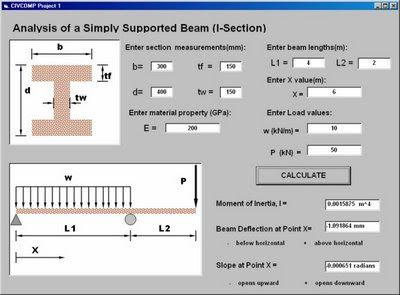


Beam Deflection Application: This is a software application for solving the elastic deflection and slope of a beam. The inputs to the program are the cross-section dimension and properties of the I-section and the beam loadings and lengths. The outputs include the moment of inertia of the I-section, the beam deflection and slope at specified point X from the left end. This application may be used in the course on Mechanics of Materials or Structural Analysis to demonstrate the effect of section properties, beam loading and lengths on the elastic deflection and slope of a beam. By computing the deflection of the beam at different values of X, the shape of the elastic curve can be drawn.


Open Channel Flow: This software application determines the normal depth of an open channel using Manning’s Equation. In this program, the user first selects the shape of the cross-section: (a ) rectangle, (b) trapezoid, or (c) triangle. The system of units have to be chosen also. The inputs to the program are the dimensions of the cross-section and Manning equation parameters, S, n and Q. The output of the program is the normal depth of flow. This software application can be used in the courses, Fluid Mechanics or Hydraulics. The values of the various parameters, such as dimensions of the cross-section, slope of channel bed, coefficient of roughness or flow rate, maybe varied to study the effect on the normal depth of flow.

You may download and try these programs at my website at http://mysite.dlsu.edu.ph/faculty/oretaa.

Wednesday, April 1, 2009

Per Tveit's Network Arches

Prof. Emeritus Per Tveit, Dr. Ing. of Agder University, Norway, visited De La Salle University, Manila a few years ago to share his knowledge and expertise about Network Arches. "When I was a student over 50 years ago, I got the idea of the network arch. Optimal network arches are arch bridges where some hangers cross other hangers at least twice. When the arches are less than 18 m apart, the tie should be a concrete slab with partial longitudinal prestress. The arches should be universal columns or American wide flanges. Network arches are best suited for spans between 80 m and 170 m, but will compete well in a wider range of spans. This results in attractive bridges that do not hide the landscape behind them. A network arch bridge is likely to remain the world’s most slender tied arch bridge, " he says. Indeed, Tveit can be considered the "father of network arches." He traveled around the world using his own resources spreading the information about network arches - the basic components, analysis, design and construction. His website has detailed information about network arches.
If you want to know more about Network Arches, contact:
Per Tveit, Dr. Ing. dosent emeritus Agder University N-4876 Grimstad, Norway

Here is a YouTube video of Mangamahu network arch bridge - the first of its type in New Zealand.

Monday, March 23, 2009

9-11 Twin Towers Attack Simulation

I just viewed this very interesting 3D simulation of the airplane crashing into the World Trade Center twin towers.

Wednesday, March 18, 2009

Popsicle Stick Bridges Slideshow

Popsicle Stick Bridge Building Competitions have become a popular activity for students here and abroad. This blogsite had many visitors who "googled" about popsicle stick bridges. Here is a slide show of the popsicle stick bridges that competed in the 5th DLSU Bridge Building Contest.


Friday, March 13, 2009

Toys for Creative Minds

If you want to develop children's creativity, patience and imagination, give them a Lego or MegaBloks. Lego or MegaBloks consist of colorful interlocking plastic bricks, beams, axles and minifigures which can be assembled and connected in many ways to contstruct various types of objects such as vehicles, buildings and even working robots. Anything constructed can then be taken apart again, and the pieces used to make other objects. Lego and MegaBloks pieces are compatible.

My two kids especially my son, Geof enjoy creating objects using Lego and MegaBloks bricks. Geof designed his own Lego twin tower almost similar to the Petronas twin towers with perfect symmetry in design and colors. He creates cars, airplanes and buildings. He usually watches Lego creations in You Tube and gets inspiration from these movies. When inspired, he will diligently and painstakingly assemble the structure from his imagination. My daughter, Julia (4 yrs old), also creates her own cars and structures.

Saturday, March 7, 2009

The Lack of Textbooks in Civil Engineering

One of the challenges to an engineering professor here in the Philippines is choosing the main textbook of his courses. Before I recommend a textbook as the main reference, I first go around bookstores specifically National Bookstore or Goodwill bookstore to check what textbooks are available. Recently, I noticed the lack of textbooks in civil engineering in commercial bookstores. What you will see are Board exam reviewers and the old edition of textbooks like Strength of Materials by Singer and Pytel. Would you believe that even if we want to replace the textbook by Singer and Pytel in Strength of Materials with a new one, we can’t – because we can’t find a replacement. In our Engineering Mechanics course, we have to write our own textbook in Statics.

I know there are new and better textbooks like those written by R.C. Hibbeler. I usually use Mechanics of Materials and Structural Analysis by R.C. Hibbeler as my main textbooks in my two courses in structural analysis. And usually I recommend the latest edition. However, I observed that these books have become scarce. Even if I inform the local distributor to make the textbooks available, the situation remains the same – NO TEXTBOOKS. Why should I recommend a textbook which is NOT available for the students to purchase?

I would like to call the attention of book publishers and distributors in the Philippines to make their textbooks in Engineering Mechanics (Statics & Dynamics), Mechanics of Materials, Structural Analysis and Structural Design (Reinforced Concrete and Steel) available in commercial and university bookstores so that the faculty can choose their main textbooks in their courses. I raised this problem also to the Commission on Higher Education (CHEd) - Technical Panel in CE during their evaluation visit at our university. Well the CHEd representative doesn’t have an answer to this ..... Ironically CHEd requires a minimum number of books and references per subject - what are they going to do about this ? Your guess is as good as mine.