Thursday, July 21, 2011

How strong is "good lumber" in compression?

Compression Failure of a short timber column

To check the safety and serviceability of wood used as columns, posts and truss members, the compressive strength of the wooden elements must be known. "Good lumber" which is available in the Philippines are usually used but their properties ae unknown. Hence, this research was conducted.

Mechanical Properties in Compression of  Commercially Available Lumber in Metro Manila
 by
Liang Ta Chen, Francis F. Ebanos and Mark Justin K. Kung


Lumber in particular vary in strength depending on different parameters such as specie, dry density, slope of grain and others. Stress grading is used to be able to use lumber’s mechanical properties. However, many lumberyards do not have stress grading for the lumber they sell. In the survey conducted by the group on lumberyards in Metro Manila, Philippines, 81% of these lumberyards have little awareness or knowledge on what kind of wood they are selling wherein they do not know the specie of the lumber they were selling or the specie of their lumber was known but were mixed and could not be identified. The common species of these so-called “good lumber” were tangile, lauan, miranthe and saba while its source are almost half imported and half local.

This research aims to determine the mechanical properties in compression of commercially available lumber used as a structural member commonly referred to as "good lumber" in Metro Manila, Philippines. Compression members are usually used as post or truss members in roof trusses. 

Lumber that were tested had varying properties. The moisture content value of good lumber ranged from 11% to 62 % while the density ranged from 319 to 729 kg/m3. The compressive strength and modulus of elasticity of “good lumber” had high coefficient of variance which means it is very distributed. Compressive strength ranged from 3.996 to 51.386 MPa while modulus of elasticity ranged from 816.4 to 7921.3 MPa. The allowable compressive strength when ASTM D6570 is imposed is 7.372 MPa which is similar to the specie Malugai of the medium strength group with 63 % stress grade in the NSCP having an allowable compressive strength of 7.35 Mpa. On the other hand, the  modulus of elasticity when ASTM D6570 is imposed is 3510 MPa which is similar to the specie Bayok of the moderately low strength group with 63 % stress grade in the NSCP having an allowable modulus of elasticity of 3740 MPa. Tests of long columns also showed that Equation from Section 617 of NSCP holds true and showed that the values computed are much smaller than the actual failure stresses. The mechanical properties of  compression members obtained from this study may guide structural designers in their design computations.
Buckling of a long timber column

Monday, July 11, 2011

Good Lumber: How "good" are you as a structural beam?


Many low cost houses used wood as structural beams for joists in floor framing systems and for purlins in roof truss systems. When you design a beam, you must know the allowable strength properties for shear and flexure and the moduus of elasticity to check whether safety and serviceability requirements are satisfied. But when you buy wood in lumberyards in the Philippines, the wood specie is not usually known. The lumberyards simply label wood used as structural members as "good lumber" and obviously the strength properties are unknown. To address this problem of a civil engineer, the following research was conducted by DLSU undergraduate students. Here is the abstract of the thesis. A paper will be presented soon in conferences in the Philippines.


Mechanical Properties on Flexure and Shear of Commercially Available Timber Beams in the Philippines
by
Earl Marvin B. De Guzman, Michael Stephen C. Go, Katrina C. Tengki


Commercially available wood used as structural members are commonly referred to as “good lumber.” Good lumber consists mostly of imported lumber, and those of lesser known or unknown local species. With the wood species not clearly specified, there is a need to determine the mechanical properties of good lumber.

This study aims to determine the variation of strength properties of timber beams classified as good lumber. Standard laboratory tests were conducted to determine the range of values of the properties of good lumber such as moisture content, specific gravity, modulus of elasticity and the bending and shear strength of timber beams. The mechanical properties of good lumber were obtained through a series of laboratory tests that simulate the conditions for the loading schemes specified in the ASTM manual, on beams of nominal cross section 2”x4”. The laboratory tests results showed that good lumber has a moisture content ranging from 12-82% with 25% as average value, a relative density ranging from 0.236-0.743, and an average modulus of elasticity of 8.15GPa. The modulus of rupture ranged from 5.7 to 63.5MPa, while the shear stress at failure ranged from 0.60 to 4.15MPa. For structural design purposes, a reduction factor of 2.1 based on ASTM Standards was applied and the allowable flexural strength obtained falls within the range 11.0-18.0MPa, while the allowable shear strength obtained is within 0.77 to 1.34MPa. Comparing the strength properties to the timber species in the NSCP 2001/2010, it was found that good lumber in general would have values within the ranges for medium and moderately low strength group for 63% stress grades. With the information on the variation of strengths of good lumber obtained from the study, structural designers would be guided on appropriate allowable stresses to be used in the design of structural members made of wood such as purlins and joists.
The student researchers, Go, Tengki & De Guzman received certificates for being a finalist for the 2011 Gold Thesis Award for the Structural Engineering Division

Saturday, July 9, 2011

An Optimum Mix Design of High Strength Concrete using Genetic Algorithms

High-strength concrete (HSC) is a highly complex and evolving construction material. Careful selection of constituent materials must be employed to successfully proportion HSC mixtures. A guide for proportioning HSC by the American Concrete Institute (ACI) is available but the guide provides only a general idea of the proportions of the various components for HSC production. Presently, batching companies produce different trial mixes using the ACI guide and some trial and error considering the observed effect of each constituent material to the strength development of HSC in order to attain a target concrete strength. This method, however, requires plenty of mix design experimentation that is costly and time consuming. Through the years, trial mixes of HSC of various strengths have been compiled by batching companies. These trial mix data may be useful in deriving optimum mix designs of HSC.

This study explored the use of genetic algorithms (GA) in deriving optimum mix designs for HSC using data collected from a batching company. Three hundred ninety-six (396) HSC trial mixtures were analyzed to derive empirical equations for strength and slump which were adapted as GA fitness functions. The GA program generated optimum preliminary designs for concrete strengths in the range of 7,000 psi (48 MPA) to 10,000 psi (69 MPa) depending on the type of sand and whether silica fume is present or not. In-situ adjustments for the dosage of admixture and amount of water were applied to the GA preliminary mix designs to account for the moisture content and absorption of the aggregates. These mix designs were verified by implementing the mixture with in-situ adjustments and testing the concrete cylinders for compressive strength. The target values for strength and slump were obtained. Cost comparison also showed that the GA-HSC mix designs yielded lower material cost than the mix designs provided by the company indicating a near optimal and more economical mix design.
This is the undergraduate thesis of Iris Mae M. Malabatuan, Bertrand B. Teodosio and Analyn C. Yee Concepcion at Department of Civil Engineering, De La Salle University, Manila. CE faculty, Engr. Alden Paul Balili, who also completed his MSCE thesis on GA with application to RC Frames was a co-adviser of the group and his GA program was used in the thesis. The thesis group is a finalist for the 2011 Gold Thesis Award for the Structural Engineering Division.

ACKNOWLEDGEMENT:
The group members and the advisers wish to express their gratitude to D. M. Consunji, Inc. and its current president, Mr. Jorge A. Consunji, for granting the request to obtain concrete mix design data.

Monday, June 6, 2011

Beware of Tsunami!

Beware of Tsunami (6:30 min)

A tsunami is chain of fast moving waves that can be triggered by an earthquake. On Dec. 26, 2004, an earthquake generated a large tsunami hitting many countries around the Indian Ocean. Among the countries affected were Indonesia, India, Thailand, Malaysia and Sri Lanka. Communities near coastal areas are highly vulnerable to tsunami. The most recent earthquake and tsunami that struck Fukushima, Japan is another reminder about the effects of a tsunami in coastal areas. Hence, public awareness about the impact and mitigation of tsunamis must be promoted.


This video is part of the  “Understanding Earthquakes and Disasters: Photo-Video Presentations,” a project funded by the DLSU-Manila University Research Coordination Office (URCO).

Thursday, June 2, 2011

QuakeBasics Photo-Video

Quake Basics photo-video presents basic concepts and definitions related to earthquakes such as plate tectonics, types of faults, focus, epicenter, locating an epicenter,  magnitude, intensity, various types of seismic waves – body and surface waves. The presentations also shows the various hazards related to earthquakes.


This is part of the "Understanding Earthquakes & Disasters" : Photo-Video Presentations, "  a project funded by the DLSU-Manila University Research Coordination Office (URCO).

Friday, April 8, 2011

Oreta TIMBER Awards 2011

At the end of the school term,  I recognize the perfromance of the students in accomplishing the requirements in our Timber Design and Laboratory class through what I dubbed as the "ORETA TIMBER AWARDS." The requirements in the laboratory course are: (1) A Field Visit to a Lumber Yard, Construction Site or Timber Structures, (2) A Field Visit to the Annual WolrdBEX, (3) Design of a Wood Floor Framing System, (4) Design of a Wood Roof Framing System, and (5) Research on a Topic Related to Wood. There is actualy no prize just a recognition. This year's awardees are:
In my Timber Design Lecture, the students are tested on their understanding of concepts, equations and code specifications on wood design through quizzes and exams. A student who excels in the exams is usually named as "Most Promising Structural Engineer." This year, Bertrand Teodosio gets the award specifically for getting a perfect score in the final exam including the bonus problem. He is Mr. 110%. Still Bertrand had to work harder - be more assertive - to realize that promise.

Wednesday, March 23, 2011

Popsicle-Stick Bridge Testing 2011

At the 7th DLSU Bridge Building Competetion, the bridges were tested using a UTM at De La Salle University-Manila CTM Lab. Two steel bars were placed on the bridge deck. Then a steel frame was placed on top of the steel bars. The load was applied on the steel frame until failure. Date of Testing: March 19, 2011. This competetion was organized by the Civil Engineering Society and was participated by students from PLM, TIP, Mapua, EARIST and DLSU.

Watch the video below. The failure of this bridge was brittle. Kaboom!


Sunday, March 20, 2011

Amazing Popsicle-Stick Bridges 2011

Slide Album: Popsicle Stick Bridges
Here is a slide show of the popsicle stick bridges that were submitted to the 7th Bridge Building Competition organized by the Civil Engineering Society at De La Salle University - Manila, Philippines. Thirty-three entries competed for the Strongest Bridge, Stiffness Champion and Best Design (Aesthetics).
Congratulation to the winners:
Strength Category: Winner - Bridge 21 (PLM)
Stiffness Category: Champion - Bridge 21 (PLM)
Stiffness Category: Runner-up - Bridge 22 (PLM)
Aesthetic Design Category: Winner - Bridge 20 (TIP)

Saturday, March 19, 2011

7th Bridge Building Contest - Best in Aesthetic Design

The winning bridge from the TIP Team

The 7th Popsicle-Stick Bridge Building Contest organized by the Civil Engineering Society of De La Salle University was held on March 19, 2011. One of the highlights of the contest was the judging of the bridges based on aesthetic design. The criteria includes originality, innovativeness, craftmanship and practicality. The judges were lead by Engr. Mario Lualhati (PICE-LNM President), Dr. Amelia Marquez (PICE-LNM Secretary) and Engr. Mike Baylon (DLSU Alumnus and FEU-East Asia College faculty). Technological Institute of the Philippines (TIP) won the aesthetic design category out of the 33 brige entries. Marvelous!


Tuesday, February 1, 2011

The Water Tour

The National Research Council of the Philippines (NRCP) organized a tour of Manila Water's Lakbayan Center at Balara, Quezon City last Jan. 28, 2011. It was an educational tour wherein lectures and video presentations about Manila Water, Path of Pat Tubig (The Mascot of Manila Water), Waste Water Treatment and Manila Water's Ondoy Activities were presented. Indeed, the lectures were enlightening. After the lectures - you will crave for Manila Water's tap water which you will realize is clean and refreshing.

The highlight of the tour is the pledging of the participants to protect the environment by signing a tumbler with some tips on environmental protection such as:
  • Re-use this drinking bottle
  • Practice proper waste disposal
  • Plant a tree
  • Support water recovery efforts so that clean water can go back to our rivers
After signing your name on your tumbler, you post a sticker leaf with your name on the wall of the Lakbayan center. After this we had a site visit of the UP STP and La Mesa Dam.

If you want to know more about water - then arrange a tour at the Lakbayan Center at Manila Water.

Tuesday, November 16, 2010

Simple Beam Deflections


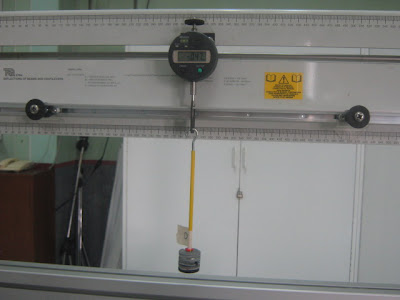
The STR4 assembly is aimed to investigate and visualize the deflection of simple beams and cantilevers. In this experiment, hanger and masses are applied on the beam and the deflection at a specific point of the beam is measured by a transducer and displayed on a digital dial test indicator.

One experment that we conducted using the STR4 was on simple beam deflections. Specifically, this experiment aims:
  • To determine the maximum deflection of a simple beam with length, L, due to a concentrated load P with varying magnitude applied at mid span.
  • To find the relationship between the maximum deflection and a point loading, P, applied at mid span.
  • To compare the maximum deflections of two types of beams with different materials and cross-section properties and determine the effect of these properties on beam deflection.

Each group was assigned a specific length of the beam and two types of materials to test. There were three types of materials available for testing: Aluminum. Brass and Steel.

The maximum or midspan deflection were measured for varying midpsan load. Graphs showing both the experimental and theoretical deflections were drawn and compared. The figures below show a comparison of the deflections for the three types of materials. The steel beam has the least deflection while the Aluminum beam has the largest deflection. The theory of elastic deflection of beams was confirmed through the experiment.


Monday, October 25, 2010

Theory of Structures Laboratory - Moment in a Beam

A new laboratory course in Theory of Structures was introduced in the DLSU BSCE curriculum. In this course, students perform laboratory experiments using TecQuipment Strucures Apparatus to investigate the behavior of simple structural members.
The first equipment used was the STR2 Moment in a Beam Apparatus. In this experimental set-up, hanger and masses are applied at specific points of the beam. There is a “cut” on the beam where the bending moment can be computed by measuring the force sensor (F) with a moment arm d from the cut. The experimental moment is equal to F times d.
The students performed two experiments using STR2. Expt. No. 1 investigated the relationship of the Moment with varying point load. A point load with increasing magnitude was applied on the beam and the Moment at a "cut" was observed. In Expt No. 2, the students observed the Moment at the "cut" when a moving load with constant magnitude was applied on the beam. They were able to derive an experimental influence line and compared with the theory.

Wednesday, August 4, 2010

Advocacy Guide for the Campaign for Safe Schools and Hospitals


“Awareness is the first step towards action” . This is the main rationale for the One Million Safe Schools and Hospitals Advocacy Guide. This primer aims to raise the awareness of the primary stakeholders of schools and hospitals - the young children, teachers, parents, medical doctors, nurses, technicians, administrators, government and the public on the urgency of making schools and hospitals safer especially in hazard-prone regions. The guide presents in simple terms the concepts of safety, hazard, vulnerability and risk and provides the reader key questions for self assessment and reflection regarding the safety conditions of his/her school or hospital. Once the need for safer schools and hospitals is appreciated, the reader will be motivated to make a pledge in the One Million Safe Schools and Hospitals Campaign to create a demand to make our schools and hospitals safer.


Read the One Million Safe Schools and Hospitals Advocacy Guide and learn more on how you can contribute in making schools and hosptials safer. Visit the campaign website at http://safe-schools-hospitals.net/.

Monday, July 19, 2010

Seismic Conceptual Design of Buildings

Here is a useful slide presentation on Basic Principles on Seismic Design which can be downloaded from www.slideshare.net.

Sunday, June 20, 2010

Structural Engineering in the Philippines


The following article can be found at the Electronic Encyclopedia of the National Research Council of the Philippines:

Structural engineering is a field of specialization in civil engineering which deals in the analysis and design of structures such as houses, buildings, towers, and bridges. A structure is a system of various types of structural elements such as beams, columns, walls, trusses arches and plates. Analyzing a structure involves representing a real structure and forces by a mathematical model and determining the critical internal forces and effects such as axial forces, shear forces, bending moment and deflections that are needed in design. Designing structures, on the other hand, requires that the structural engineer satisfies the requirements for strength, serviceability and economy.
For the protection of public life and property, the design of structures and the preparation of structural plans for their construction have to be controlled and regulated. In the Philippines, the National Structural Code of the Philippines (NSCP) is adapted as the referral code for structural design. The NSCP prescribes the minimum requirements in terms of strength, serviceability and ductility of buildings and other structures.

There are two volumes of the NSCP – Volume 1 is for Buildings, Towers and Other Vertical Structures and Volume 2 is for Bridges. Although many provisions of the NSCP have been derived from codes developed in the United States like the Uniform Building Code (UBC), ACI code of the American Concrete Institute and codes of the American Society of Civil Engineers (ASCE), however, there also provisions that are adapted to Philippine conditions such as those related to wind loading, seismic design and timber design. The NSCP is continuously updated and published by the Association of Structural Engineers of the Philippines, Inc. (ASEP).

The Association of Structural Engineers of the Philippines, Inc. (ASEP) was incorporated by 32 charter members in September 1961 with Ambrosio Flores as the founding president. Among the past ASEP presidents were Abelardo Carillo, Angel Lazaro Jr., Lauro Cruz, Cesar Caliwara, Octavio Kalalo, Ernesto Tabujara, Primo Alacantara and Ernesto de Castro. Aside from the NSCP, ASEP also published the Steel Handbook, Earthquake Design Manual, Proceedings of the ASEP International Conventions and other Conferences such as the Asia Conference on Earthquake Engineering (ACEE). After the 1990 Luzon Earthquake, ASEP also initiated the Disaster Quick Reaction Survey Teams for rapid documentation and assessment of structural and geotechnical damage to buildings, bridges and other structures after a disaster. ASEP collaborated with the Philippine Institute of Civil Engineers (PICE) in the Disaster Quick Reaction Program (DQRP). In July 28, 2006, the National Disaster Coordination Council (NDCC) of the Philippine Government recognized the efforts of ASEP and PICE through the Gawad Kalasag Award.

In 2006, the PICE amended its by-laws creating five specialty divisions – one of them is Structural Engineering. Membership in the specialty divisions is open to Life members or Fellows in good standing of the PICE. A specialty examination is required for admission in the specialty divisions starting January 2008.