
Engr. Rodolfo "Mac" Mendoza, now a Doctoral student at Nagoya University, Graduate School of Civil Engineering guides us on a tour of Nagoya University and the city.
Tuesday, February 16, 2016


Wednesday, July 29, 2015
Quantifying the Environmental Impacts of Standard Bridge Designs
“A Proposed Methodology for Quantifying the Environmental Impacts of
Structural Elements of Standard Bridge Designs”
A thesis prepared and submitted by:
Kevin Lawrence M. Atienza
Carla Maria B. Gonzalez
Jorge Jason K. Joaquino
Mitchel Krisia R. Martinez
April 2015
To take into account the environmental sustainability aspect of bridge designs, the study presented a methodology to numerically measure the amount of emission different bridges produce. The researchers gathered a total of eighteen bridge plans of various structural systems such as Reinforced Concrete Deck Girder (RCDG), Pre-stressed Concrete Deck Girder (PCDG), Reinforced Concrete Slab, Steel Girder, and Reinforced Concrete Box Culvert (RCBC). Each plan included a bill of quantities that summarized the type of material and the amount used upon construction. Using LCIA database Ecoinvent v3.1, quantities were translated into corresponding environmental impacts namely Acidification, Eutrophication, Global Warming Potential, Photochemical Oxidant Formation, Stratospheric Ozone Depletion, and Depletion of Abiotic Resources. Numerical results were divided by the total area of the bridge leaving one square meter of bridge area as the functional unit of choice.
To normalize these values, each environmental impact equivalent was divided by the largest value, which was produced by the RCBC bridge design. An Analytical Hierarchy Process (AHP) was conducted to produce the weighting factors of each impact. The normalized values were then multiplied by their corresponding weighting factors and added up to produce an Environmental Impact Score (EIS) that was used to rank and compare the environmental performance of each bridge. In this particular study, the RCDG bridge design generated the lowest score with a value of 0.451, thus indicating that it produced the least amount of impact. On the other hand, the RCBC bridge design produced the largest amount of impact with an EIS of 0.825. Through the proposed methodology of conducting a Life Cycle Impact Assessment (LCIA) and producing an EIS, structural engineers will be able quantify the environmental impacts of different bridge structural systems and in turn apply sustainability in the decision making of future bridge projects.
To normalize these values, each environmental impact equivalent was divided by the largest value, which was produced by the RCBC bridge design. An Analytical Hierarchy Process (AHP) was conducted to produce the weighting factors of each impact. The normalized values were then multiplied by their corresponding weighting factors and added up to produce an Environmental Impact Score (EIS) that was used to rank and compare the environmental performance of each bridge. In this particular study, the RCDG bridge design generated the lowest score with a value of 0.451, thus indicating that it produced the least amount of impact. On the other hand, the RCBC bridge design produced the largest amount of impact with an EIS of 0.825. Through the proposed methodology of conducting a Life Cycle Impact Assessment (LCIA) and producing an EIS, structural engineers will be able quantify the environmental impacts of different bridge structural systems and in turn apply sustainability in the decision making of future bridge projects.
Special Acknowledgement:
DPWH Staff and Engineers for sharing bridge data,
Dr. Mike Promentilla (DLSU ChE Dept) for guidance in the AHP procedure
Wednesday, April 22, 2015
A Call for Support - The 6th ASIA Conference on Earthquake Engineering (6ACEE 2016- Cebu City, Philippines)
The 6ACEE returns to the Philippines and will again be hosted by ASEP on September 22-24, 2016 on the occasion of its anniversary and the 3rd anniversary of the 2013 Bohol Earthquake. The orgainizers plan to hold the 6ACEE at a venue in Cebu City. The theme of the 6ACEE is "Bridging Theory and Practice in Earthquake Engineering for Enhancing Community Resilience."
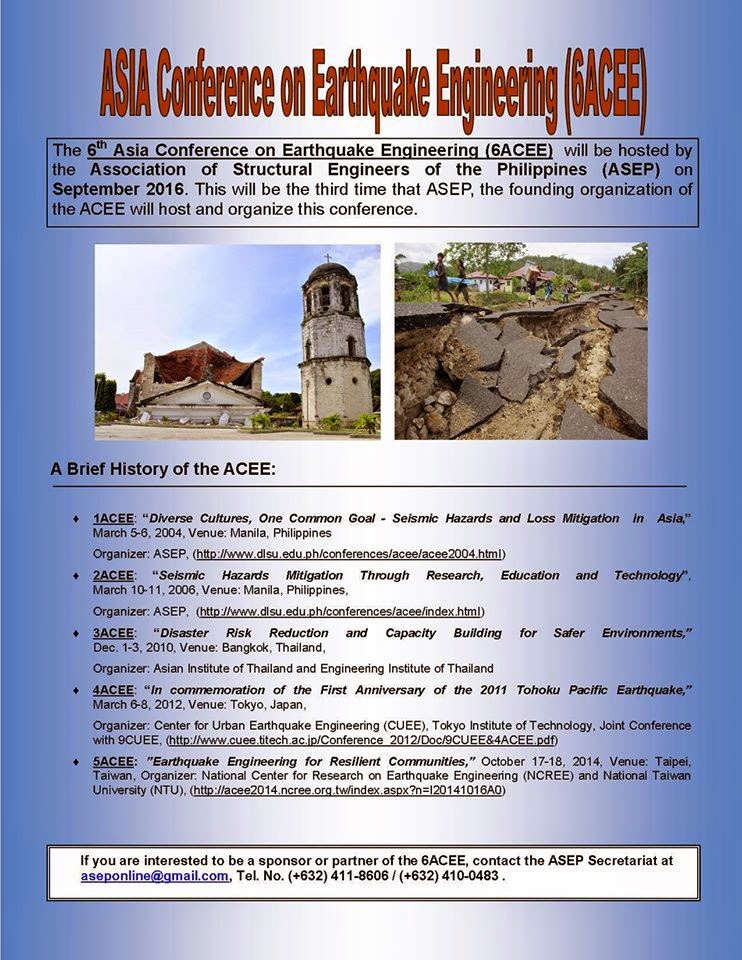
- 1ACEE: “Diverse Cultures, One Common Goal - Seismic Hazards and Loss Mitigation in Asia,” March 5-6, 2004, Venue: Manila, Philippines, Organizer: ASEP, (http://www.dlsu.edu.ph/conferences/acee/acee2004.html)
- 2ACEE: “Seismic Hazards Mitigation Through Research,
Education and Technology”, March 10-11, 2006, Venue: Manila, Philippines, Organizer:
ASEP, (http://www.dlsu.edu.ph/conferences/acee/index.html)
- 3ACEE: “Disaster Risk Reduction and Capacity Building for Safer Environments,” Dec. 1-3, 2010, Venue: Bangkok, Thailand,Organizer: Asian Institute of Thailand and Engineering Institute of Thailand
- 4ACEE: “In commemoration of the First Anniversary of the 2011 Tohoku Pacific Earthquake,” March 6-8, 2012, Venue: Tokyo, Japan,Organizer: Center for Urban Earthquake Engineering (CUEE), Tokyo Institute of Technology, Joint Conference with 9CUEE, (http://www.cuee.titech.ac.jp/Conference_2012/Doc/9CUEE&4ACEE.pdf)
- 5ACEE: ”Earthquake Engineering for Resilient Communities,” October 17-18, 2014, Venue: Taipei, Taiwan, Organizer: National Center for Research on Earthquake Engineering (NCREE) and National Taiwan University (NTU), (http://acee2014.ncree.org.tw/index.aspx?n=I20141016A0)
Strategies on how to increase the participation of interested stakeholders from various Asian countries- civil engineers, structural engineers, seismologist, DRRM experts and advocates - must be explored. One suggestion is to involve the various professional organizations interested in earthquake engineering from the various Asian countries to be supporting organizations of the 6ACEE. Hence, we call on these organizations such as the Japan Association on Earthquake Engineering (JAEE), Engineering Institute of Thailand and the professional organizations from Indonesia, Malaysia, Singapore, India, Taiwan, China, Korea and even Australia and New Zealand to support the 6ACEE.
Friday, April 3, 2015
OBE3 Team: Promoting Effective OBE in the Classroom

"Outcomes-Based Education for Engineering Educators" or OBE3 started in April 2012 when the Dr. Pag-asa Gaspillo, President then of the Philippine Association for Technological Education (PATE) invited us to design a seminar-workshop to promote OBE to PATE faculty members. The team, composed of Dr. Manuel Belino, Engr. Efren Dela Cruz and I, designed the course entitled "Effective OBE in the Classroom." The seminar-workshop primarily targets the teachers who are the ones delivering the courses of the engineering curriculum. The course is principally concerned with improving the quality of the teaching and learning process in the classroom. Accreditation is secondary, because if the teachers can effectively practice OBE in the classroom, then the present requirements on accreditation which based on OBE can be easily achieved.
The seminar workshop on "Effective OBE in the Classroom" consists of the following lectures:
- Understanding OBE. Why OBE? Global Trends. Designing your PEOs. - Dr. Manny Belino
- What are Student Outcomes? - Dr. Manny Belino
- Writing Course Learning Outcomes and Course Design - Dr. Andy Oreta
- Using Various Assessment Tasks - Dr. Andy Oreta
- Introducing a Variety of Teaching and Learning Activities - Engr. Efren Dela Cruz
- Designing an OBE Syllabus - Engr. Efren Dela Cruz
- Writing the Program Educational Objectives (PEO) for a specific Program
- Curriculum Mapping
- Writing Course Learning Outcomes for a Course You Teach
- Converting your syllabus to OBE format
After the 2012 PATE seminar-workshop, the OBE3 team was invited to conduct similar lectures and workshops in various schools like Colegio de San Juan De Letran, Pamantasan ng Lungsod ng Maynila, Capiz State University and Northwestern Samar University. At the start of the seminar-workshop, there was resistance from the participants. For them adjusting to OBE is an additional burden. However, after Dr. Belino's inspiring lecture on Why OBE?, the participants realize the need to go to OBE, otherwise the engineering graduates will not be globally competitive. After the activity, the team hopes that the participants can effectively apply the OBE principles in the classroom. The saying, "It is only by doing that we learn" should always be in the minds of the teachers for them to understand and appreciate OBE.
 |
| Capiz State University (2013) |
 | |
| Collegio de San Juan De Letran (2014) |
 | ||||
| Northwestern Samar State University (2015) |
For more information about OBE3, email:
O-Dr. Andy Oreta - andyroreta@yahoo.com
B-Dr. Manny Belino - mcbelino@mapua.edu.ph
E-Engr. Efren Dela Cruz - efren.delacruz@dlsu.edu.ph
Friday, June 6, 2014
Useful Ideas from the Felder-Brent Workshop on Effective Teaching for OBE
 |
| Hotel Puteri Pacific, Johor Bahru, Malaysia |
 |
| Brent (2nd from left) and Felder(3rd from left) |
1. You can get more feedback from "active learning" and "questioning." Felder and Brent demonstrated during the workshop how active learning can be done effectively in the classroom. In active learning, students do things in class related to the course. During the workshop, Felder asked the participants to group in pairs or three members. Then he pose a question or problem which the group must discuss within a few minutes (from one minute to three minutes depending on the problem). One member is tasked to record the group's output from the short discussion. Felder then asked selected members from various groups about their outpus. In about ten minutes, we got various answers and suggestions from the participants. He compared active learning strategy to individual questioning where in the teacher asked the whole class and then look for volunteers. In this case, you will find very few students willing to answer your question because most of them are shy or passive.
Why does this strategy work? Felder says students when they have interaction with fellow students, they get engaged in the activity. And when the teacher asked for their answers, the students are less shy because what he/she is sharing to the class is a group output not only his/her own. The students are awake during the short active learning activity and participate in the group discussion because they want to be prepared for an answer in case the teachers calls them. Don't worry about the noise students make during the group discussion. It's worth it than a quiet class where learning doesn't take place.
Useful idea: In a 90-minute lecture, students get bored if the teacher is the center of the teaching-learning process. Students should be more actively engaged. Short active learning activities during the 90-minute class is effective - it makes students awake, get them engaged and thinking and the activity also promotes collaborative learning.
2. Initiate opportunities where the students start thinking. Students should not be passive learners but active learners. As stated earlier students learn more on active learning. Before coming to class, review your notes and examples. Think of questions that you may pose to the students and apply active learning to make them think during the lectures. Use varied and challenging questions so that student can apply the lower and higher thinking skills. Instead of using "Is that clear?" or "Any questions?", ask questions similar to the photo below such as "What if I use a different section?", or "How could we improve the process?"
 | |||
| Asking varied questions make students apply the various thinking skills (PPT slide form the Felder-Brent Workshop). |
 |
| Active learning activity in TSTRUC1 - Meeting No. 1 |
During
the one-minute activity, the students get engaged in the discussion, the class
obviously was noisy but they are awake. After one minute I called on students
randomly from various pairs and I got good answers from the various groups. I
have been doing this in my class in TSTRUC1 during the first meeting but in the
past they do it individually. I got better, faster and more answers this time
when I use pairings. Among the responses given were: type of material, available
material, available equipment, allowable stress, weight of person, number of
persons, span length, cross-sectional shape, temperature, environment, site, soil
type, cost and budget. From the data gathered, I discussed the basic procedure
of designing a simple beam bridge using their data and the principles of
structural design using concepts from STATICS and MEDEFOR only. Span length,
soil type as support and total load (weight and number of persons) are needed
to model the bridge and solve the reactions, maximum shear and bending moment.
The cross-sectional shape is necessary to determine the moment of inertia and
location of the centroid of the section. The type of material is important to
make an estimate on the allowable stress and the modulus of elasticity (E) of
the beam bridge. The site and its environment are important if you are consider
other environmental loads (temperature, wind, seismic, flood, etc). And
finally, the budget becomes a constraint to your design as it will limit the
cost of the bridge. The activity was very informative and new to them as they
were introduced on how theory is applied to a real world civil engineering
problem. About ten minutes were used effectively to review basic concepts in
STATICS and MEDEFOR.
---------------------------------------------------------------------------------
I shared this blog to Prof. Felder on June 7, 2014 and he immediately sent me this reply (June 8).
Dear Andres,
Thanks so much for sharing the blog entry with me. It really pleases
Rebecca and me that you got as much as you did from the workshop and you put it
to use in your teaching that quickly. The beam bridge exercise is excellent. I
wish my statics professor had done something like it when I was taking the
course many years ago.
Congratulations too on an outstanding blog. Your students are lucky to have
you as a resource.
Best regards,
Richard
Richard
Felder
Hoechst Celanese Professor Emeritus of Chemical Engineering
North Carolina State University
www.ncsu.edu/effective_teaching
Hoechst Celanese Professor Emeritus of Chemical Engineering
North Carolina State University
www.ncsu.edu/effective_teaching
Monday, October 21, 2013
Addressing Safety & Sustainability of Infrastructures in Hazard-Prone Countries
 |
| Keynote Paper delivered at Nagoya University's International Forum on CE Infrastructure Technology Transfer, 31 August 2013 |
Abstract
“Civil Engineers shall hold paramount the safety,
health and welfare of the public and shall strive to comply with the principles
of sustainable development in the performance of their duties.” This is one of
the fundamental canons of the Code of Ethics of Civil Engineers. The task of a
civil engineer includes provision of safe, reliable and comfortable
infrastructures for housing, transport, communication, water supply and
sanitation, energy, commercial and industrial activities to meet the needs of a
growing population. Today, there is an increasing demand for civil engineers to
focus their efforts on the protection and preservation of the environment. With
the increase in severity and frequency of natural disasters that devastated both
developing and advanced countries, planning,
design and construction of infrastructures that are safe for people and at the
same time reduce their impact on further deterioration of the environment
becomes a major challenge. Civil engineers who are experts in the various
fields of specialization in structural engineering, transportation engineering,
water resources engineering, geotechnical engineering and construction
engineering must embed in their tasks disaster risk reduction especially in
hazard-prone regions – for when they do this, they not only address safety but
also sustainability – two important issues for maintaining the balance and
harmony between the built and natural environment. |
| Living in hazard-prone regions. Achieving safety and sustainability
is a major challenge in regions or countries that are vulnerable to adverse
natural hazards like earthquakes, typhoons, floods, volcanic eruptions, drought
and tsunamis. The vulnerabilities of the built environment to a hazard
depend on the safety provided and sustainability features. The disaster will
have impacts on both the built and natural environment. READ THE FULL PAPER |
Sunday, June 9, 2013
Greener Designs of Buildings using the Structural Sustainability Index
Sustainability is a
concern that must also be addressed by structural engineers. Structural
engineers must be able to discriminate as to which materials and processes
would have a lesser impact to the environment, and to coordinate with the other
stakeholders of the structure. The concept of the study is to enable the
structural engineer to analyse the sustainability of structural systems in a
quantifiable manner.
In
designing a house, or any structure, there are three things commonly considered
by the structural engineer. Namely: safety, serviceability and cost. Safety and
serviceability ensure that the structure can fulfill its intended purpose by
satisfying code requirements on strength, ductility and deflections. Addressing
economy, on the other hand, requires value engineering to produce an optimum
design with reasonable cost. There is now an increasing concern about the
environmental impact of structures. Sustainable design of houses must be
pursued to address this concern. But what parameter may be used to guide
structural designers to make their structures “greener”?
In an undergraduate thesis, the environmental
impact of the structural systems and envelope of selected housing units for a
middle class family in the Philippines
The image below is a poster submitted to the ASEP Student Research Competition during the 16th ASEP International Conference held on May 23-25, 2013.

Sunday, September 16, 2012
Open Ended Problems in Mechanics of Materials
Problem solving is one learning activity that is extensively employed by engineering educators. “Problem-solving is defined as a process used to obtain a best answer to an unknown or a decision subject to some constraints” (Mourtos 2004). Through problem solving students learn to apply the theoretical equations in both hypothetical and real-world scenarios. Assigning problem sets provides students the opportunity to test their understanding of the theory and concepts. The type of problems assigned to students addresses various levels of thinking and outcomes. Traditionally, problems are designed with given parameters and students are required to determine an unknown quantity. The solution usually involves substitution of known values to an equation to solve for the unknown parameter. Problems of this type are said to be “close-ended.” Close-ended questions usually have a unique answer and the procedure of obtaining the answer is limited or straight-forward. Close-ended problems address lower levels of thinking (based on Bloom’s taxonomy) like “remembering”, “understanding” and “applying” and some higher mode of thinking like “analyzing”.
To address higher levels of thinking like “evaluating” and “creating” and transformative outcomes experienced in the real-world, “open-ended” questions should also be included in the problem sets. Sobek and Jain (2004) emphasized the need for open-ended problems. “Employers look for engineers who are effective at solving open-ended problems. Engineering accreditation demands evidence that students can tackle open-ended problems proficiently.” Open-ended problems address considerably the student outcomes on “an ability to recognize, formulate, and solve civil engineering problems” and “an ability to engage in lifelong learning.” Open-ended questions are usually ill-defined and there may be more than one valid approach to obtain the solution. As a matter of fact, the solution may not be unique because of varying assumptions made regarding some parameters. Mourtos (2004) noted in their study that “traditional exercises (close-ended) found in most engineering texts, although useful, do not adequately prepare engineering students for real-world problems. Students seem to have great difficulty approaching these (open-ended) problems; however, they also seem to enjoy the challenge and perform reasonably well if given proper guidance.”
 |
Problem : If you were to install a
steel Z-purlin, which arrangement
would you choose to maximize the
moment capacity of the section?
|
In the problem sets in my structural analysis course, open-ended problems are given. The problem shown about a Z-purlin is related to analysis of beams due to unsymmetrical bending which is similar to a problem by Singer. Deciding on the most effective set-up of the Z-section whether upright or inverted would require application of concepts in moment of inertia, equilibrium, bending moment and elastic bending stress analysis. There are various ways of determining the more efficient arrangement of the Z-section. You may compute which arrangment has the larger moment capacity. You can assume a moment and compute the maximum stresses and compare.
Mourtos, N. et al. (2004). “Open-ended problem solving skills in thermal-fluids engineering,” Global Journal of Egg Education, UICEE
Sobek, D and Jain V. (2004). “The Engineering Problem Solving Process: Good for Students?” Proc.2004 American Society for Engineering Education (ASEE) Annual Conference & Exposition
NOTE: An updated version of this article - "Challenging Students' Thinking Through Open-ended Problems" was published as e-notes in The Philippine Engineering Education (Vol. 1, No. 1, Sept 2013) - the official news magazine of the Philippines Association for Technological Education (PATE).
NOTE: An updated version of this article - "Challenging Students' Thinking Through Open-ended Problems" was published as e-notes in The Philippine Engineering Education (Vol. 1, No. 1, Sept 2013) - the official news magazine of the Philippines Association for Technological Education (PATE).
Tuesday, September 4, 2012
Using Visual Gobbets in Teaching
A gobbet is “an extract of text, a passage of literature, an image, a cartoon, a photograph, a map or an artifact provided as a context for analysis, translation or discussion in an assessment” (Chan 2008). “The student’s task is to identify the gobbet, explain its context, say why it is important, what it reminds them of or whatever else you would like them to comment on” (Biggs and Tang 1999). Gobbets are usually used for assessment.
I used "visual" gobbets in my class in Theory of Structures and Earthquake Engineering. Here are some examples.
In my first meeting in Theory of Structures-I, as my review of basic concepts in Statics and Mechanics of Deformable Bodies, I displayed an image of a beam bridge and posed the problem to the students: “if you are required to design a simple beam bridge to cross a river, what information would you gather to accomplish your task and how would you use the information?
 |
| A Gobbet on Simple Beam Analysis & Design |
• A beam bridge can be modelled as a simple beam with length, L and the weights represented as concentrated loads
• Analysis means solving for reactions and maximum internal forces – moment and shear
• The type of material will specify the material strength (allowable stresses) and mechanical properties (modulus of elasticity)
• Designing the beam means determining the shape and size of the beam
• Various types of design can be done for comparison (strength, cost)
Another gobbet in my Earthquake Engineering class was included in an exam to assess the students’ understanding of structural failure due to earthquakes. This is an exercise on post-earthquake evaluation usually conducted by structural engineers (ASEP) after the occurrence of an earthquake. The students are shown photos of a building damaged due to earthquake. A description of the observed damage is also given. The students are required to assess the condition of the building based on the photos and description and recommend the appropriate post-earthquake posting (Safe, Limited Entry or Unsafe).
 |
| "Safe", "Limited Entry" or "Unsafe"? nisee.berkely.edu |
The third example of a gobbet exercise which I called “Scaling an Earthquake” was applied in the Earthquake Engineering course. One of the learning outcomes of the course is familiarization with the PHIVOLCS Earthquake Intensity Scale (PEIS). A series of photos were displayed to the class and the following problem was posted: “You are tasked to determine the intensity of the earthquake using PEIS. Assign the intensity scale for each photo. Explain your answer.” In this exercise, the students have to read and understand carefully the descriptors for each intensity scale in PEIS and relate them to the photos.
| Rate the Intensity Scale of this Earthquake http://woldcnews.com/ |
References
Biggs, J. and Tang, C. (1999). Teaching for Quality Learning at University, McGraw-Hill Open University Press Chan C. (2008) “Assessment: Gobbets”, Assessment Resource Centre, University of Hong Kong [http://arc.caut.hku.hk]: Available: Accessed: 8/27/2012
Thursday, August 30, 2012
What is a soft story?
One of the requirements in my undergraduate course (STEQUAK) at DLSU is a group research related to earthquake engineering. The group has to present their topic orally using multimedia - powerpoint slides and a short video. The group of Gian Panaligan, Jerome Sy, Jospeh Oropel and Janelle Ong created a video about their topic, "How can we improve the seismic performance of a building with a soft story?" The language used is Filipino and their acting is very natural. A good story about a "soft story." Watch and enjoy.
 |
| Our last meeting - STEQUAK (Earthquake Engg) Class 8/30/2012 |
Tuesday, June 5, 2012
Theory of Structures: An Introduction
Here is a powerpoint slide show of my lecture on the introduction to the Theory of Structures.
Monday, March 12, 2012
Model Popsicle-Stick Bridges of the Bridges in Asia
 |
| Chaotianmen Bridge (China)
In the recent Civil Engineering Society Bridge Building Contest, students from various civil engineering schools in Metro Manila were challenged to create popsicle stick bridges based on a segment of an actual bridge that can be found in the Asian region. The judging of the bridges took place last March 10, 2012 at the De La Salle University, Manila. It was a marvel to see the creativity of the students. There were model bridges that were really awesome and created meticulously following the photo of the actual bridge. The winner for the best design was the model of the Chaotianmen Bridge (China) submitted by the students from TIP. Marvel at the popsicle stick bridges below.
|
 |
| Asahibashi Bridge (Japan) |
 |
| Asahibashi Bridge (Japan) |
 |
| Ayala Bridge (Manila, Phils) |
 |
| Zhejiang Road Bridge (China) |
 |
| Merdeka Bridge (Malaysia) |
 |
| Minamikawa Bridge (Japan) |
 |
| Wanxian Bridge (China) |
 |
| Quezon Bridge (Manila, Phils) |
 |
| Dhamra Bridge (India) |
 |
| Best Bridge Design |
Monday, February 20, 2012
Meeting the Gurus of Outcomes-Based Teaching & Learning
 |
| John Biggs lectures at TIP (2012) |
"The key to 'constructive alignment' is that all components in the teaching system - the curriculum and its intended outcomes, the teaching methods used, the assessment tasks - are aligned to each other. The teacher's job is to create a learning environment that supports the learning activities appropriate to achieving the desired learning outcomes, " says John Biggs, psychologist, educator and author and the man behind 'constructive alignment' and the SOLO taxonomy.
I met John Biggs and his wife and co-author, Catherine Tang at the International Conference on Outcomes-Based Teaching and Learning (ICOBTL) held on Feb. 16-17, 2012 at the Technological Institute of the Philippines, QC Campus. Biggs and Tang were the keynote lecturers at the ICOBTL which was attended by about 500 teachers, professors, university presidents and heads from CHED, DepED, PATE and PTC.
As I mentioned in my previous blog, I have been learning about outcomes-based education (OBE) and I have learned much from the papers of Biggs and Tang. Their rationale for constructive alignment (CA) which is an example of OBTL is quite noble. Biggs say CA is "concerned only with improving teaching and learning" unlike the other proponents who apply OBE for accrediation purposes.
Applying OBE is not something new. The new terms like 'constructive alignment', 'intended learning outcomes' or ILO, 'teaching and learning activities' or TLA and 'assessment tasks' or AT should not intimadate the teacher. OBE or OBTL or CA has been practiced by teachers consciously or unconsciously. What the teacher should do is simply to understand the concepts and refocus his/her teaching and learning activities and assessment tasks to address learning outcomes. With OBE, there is more focus on what the teacher and student should do. This is the challenge in OBE especially for engineering educators. How can you effectively apply OBE in the teaching of a technical course with a lot of theory like 'Engineering Mechanics' or 'Theory of Structures.' I am still groping for effective strategies aside from traditional classroom lectures and I will report on this in the future.
 |
| Catherine Tang, John Biggs, my co-faculty at DLSU - Alvin Chua and I |
Wednesday, January 18, 2012
Outcomes-Based Education: As I see it

I was tasked by the dean and department chair to be a "champion" for outcomes-based education (OBE). The main motivation for this is that OBE may be used in the accreditaion of engineering programs in the Philippines following the accreditation practice (ABET) in the US. But how can I be a champion when I don't have any idea about OBE. I attended a series of seminars conducted by DLSU educators but somehow it was difficult to comprehend the topics because the seminars combine UBD, OBE, Transformative Learning, Student-Centered Learning, etc. So I have to do my own readings of scholarly papers on OBE by experts like Spady, Biggs, Rogers and Feldman especially those related to ABET and engineering . After reading these papers and reflecting on them, I came up with a diagram (shown above) of "the OBE Framework" as I understand it. Here are some of my thoughts about OBE.
- OBE is a “student-centered learning philosophy that focuses on empirically measuring student performance, which are called outcomes.”
- Outcomes are clear learning results (knowledge, skills, values, behavior) that learners have to demonstrate at the end of significant learning experiences.
- Outcomes follow a hierarchy: (a)University level: the mission and vision defines the expected graduate attributes, (b) Program level: Program educational objectives (PEO) describe what graduates are expected to attain within three to five years after graduation, (c) Program level: Student outcomes describe what students know and can do after graduation, (d) Course level: Learning outcomes describe what the students know and can demonstrate at the end of the course.
- Defining the outcomes is the key in curriculum and course design and delivery. The teaching methods, leanring activities, topics and assessment tools must be aligned with the outcomes.
- At the end of the course or program, an assessment must be done to determine whether the outcomes were achieved or not. The purpose of asssessment is to provide a continuous process of planning, measuring, analyzing results, and using the results to make informed decisions that, preferably, lead to improvements.
Now that OBE has started to be come a framework in the teaching-learning process in the university, how will this affect me and my colleagues? I have been in the academe for more than 20 years (five years at UP and 17 years at DLSU). When I reflected on the OBE paradigm and my present teaching practice, I can see that I need to make a few adjustments:
- I must explain to the students at the start of the term that they should address the learning outcomes in all their learning activities - readings assignements, exams, etc.
- I must always refer to the syllabus and make sure that my teaching-learning activities and assessments (exams, assignments, etc) are aligned with the learning outcomes.
- I must use various learning activities to develop the students' interest in the classroom. Available technology (youtube, internet, etc.) must be explored.
- I must explore creative ways of delivering course content. I should deliver only the most important content in lectures and the other related content through other means (e.g. internet).
- I must regularly assess on whether the learning outcomes are being achieved through seatworks, recitation and homeworks. These assessments need not be part of the final grade but must be used to improve the teaching-learning process during the term. If I observe some weakness in a specific topic, then I need to make adjustments on that topic.
- I must design an assigment on how I can assess the "skills, knowledge, behavior" of students related to the course and relate to real world tasks to achieve "transformational" outcomes.
Moving from traditional methods to outcomes-based takes time. As a start, an OBE syllabus must be designed by the faculty. Then gradually the faculty should change his/her teaching practices (e.g. combine various activities in lectures) and eventually teaching based on OBE becomes natural. This I hope to achieve.
Wednesday, October 5, 2011
Simply Mechanics: Equilibrium of a Fish Mobile
A mobile is a decorative structure that is suspended so as to tur n freely in the air. A mobile usually consists of pieces of rods and decorative shapes made of metal, wood, plastic or paper suspended in midair by wires, strings or ties so that the individual parts can move independently when stirred by a breeze.
 n freely in the air. A mobile usually consists of pieces of rods and decorative shapes made of metal, wood, plastic or paper suspended in midair by wires, strings or ties so that the individual parts can move independently when stirred by a breeze.
The principles in engineering mechanics about force systems in equilibrium can be demonstrated by analyzing the equilibrium condition of a mobile. Consider the fish mobile which hangs in our room. The fish mobile is an example of a parallel force system. All forces acting on the horizontal rods are vertical since only gravity loads due to the weights of the hanging objects act. I laid the mobile on a flat surface and this is how it will appear as a parallel force system.
 |
| The Fish Mobile as a Parallel Force System |
Haven’t you wondered how much force each wire supports to keep the mobile in equilibrium? Let’s apply the principles of engineering mechanics to answer this query. Here is model of the fish mobile as a parallel force system and the free body diagrams (FBD) of the rods supporting the fish mobile whrere the fish shapes are represented by their weights (W) and the tensile forces acting on the wires are represented as T1, T2, T3 and T4.


To compute the force acting on wire no. 4, the FBD with T4 is used and the equilibrium equation of summation of forces with respect to the vertical axis is applied. The upward forces should be equal to the downward forces. Hence, T4 = 2W. Similarly, the forces on the other wires can be computed by using the appropriate FBDs. Thus,
T3 = 3W. T2 = T4 + W = 2W + W = 3W.
T1 = T2 + W + T3 = 3W + W + 3W = 7W
The mass of each fish object is about 10 g or 0.01 kg which is equivalent to 0.0981 N. Hence, the tensile force acting on wire no. 1 is T1 = 7(0.0981 N) = 0.6867 N.
Except for second rod, all rods have symmetrical loading resulting to the wire located at the middle of the rod. However, for the rod where T2 acts, the force at the right is T4=2W and the force at left is W. For equilibrium, the location of the T2 is closer to right. An equation of equilibirum (summation of moments) may be used to determine the location of the wire for this rod.
The arrangement of the rods and hanging objects on a mobile will affect the magnitude of the forces acting on the wires. In the design of a mobile, the following factors should be considered: (a) Mass of the each hanging object and (b) Length of each rod. The location of the wire on the rod depends on the weights supported by the rod. If the weights are hanged symmetrically, then the wire is placed at the midspan of the rod to satisfy equilibrium. However, for unsymmetrical loading where the weight at the left is not equal to the weight at the right, the location can be obtained by applying the equation of equilibrium for moments.
Equilibrium of a fish mobile? That's simply mechanics.
Equilibrium of a fish mobile? That's simply mechanics.
Subscribe to:
Posts (Atom)


