
At the 7th DLSU Bridge Building Competetion, the bridges were tested using a UTM at De La Salle University-Manila CTM Lab. Two steel bars were placed on the bridge deck. Then a steel frame was placed on top of the steel bars. The load was applied on the steel frame until failure. Date of Testing: March 19, 2011. This competetion was organized by the Civil Engineering Society and was participated by students from PLM, TIP, Mapua, EARIST and DLSU.
Watch the video below. The failure of this bridge was brittle. Kaboom!
Wednesday, March 23, 2011


Sunday, March 20, 2011
Amazing Popsicle-Stick Bridges 2011
 |
| Slide Album: Popsicle Stick Bridges |
Congratulation to the winners:
Strength Category: Winner - Bridge 21 (PLM)
Stiffness Category: Champion - Bridge 21 (PLM)
Stiffness Category: Runner-up - Bridge 22 (PLM)
Aesthetic Design Category: Winner - Bridge 20 (TIP)
Saturday, March 19, 2011
7th Bridge Building Contest - Best in Aesthetic Design

 The winning bridge from the TIP Team
The 7th Popsicle-Stick Bridge Building Contest organized by the Civil Engineering Society of De La Salle University was held on March 19, 2011. One of the highlights of the contest was the judging of the bridges based on aesthetic design. The criteria includes originality, innovativeness, craftmanship and practicality. The judges were lead by Engr. Mario Lualhati (PICE-LNM President), Dr. Amelia Marquez (PICE-LNM Secretary) and Engr. Mike Baylon (DLSU Alumnus and FEU-East Asia College faculty). Technological Institute of the Philippines (TIP) won the aesthetic design category out of the 33 brige entries. Marvelous!


Tuesday, February 1, 2011
The Water Tour
 The National Research Council of the Philippines (NRCP) organized a tour of Manila Water's Lakbayan Center at Balara, Quezon City last Jan. 28, 2011. It was an educational tour wherein lectures and video presentations about Manila Water, Path of Pat Tubig (The Mascot of Manila Water), Waste Water Treatment and Manila Water's Ondoy Activities were presented. Indeed, the lectures were enlightening. After the lectures - you will crave for Manila Water's tap water which you will realize is clean and refreshing.
The highlight of the tour is the pledging of the participants to protect the environment by signing a tumbler with some tips on environmental protection such as:
- Re-use this drinking bottle
- Practice proper waste disposal
- Plant a tree
- Support water recovery efforts so that clean water can go back to our rivers
After signing your name on your tumbler, you post a sticker leaf with your name on the wall of the Lakbayan center. After this we had a site visit of the UP STP and La Mesa Dam.
If you want to know more about water - then arrange a tour at the Lakbayan Center at Manila Water.
Tuesday, November 16, 2010
Simple Beam Deflections

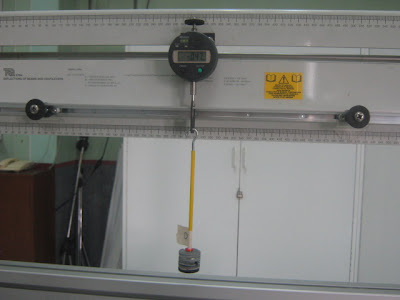
The STR4 assembly is aimed to investigate and visualize the deflection of simple beams and cantilevers. In this experiment, hanger and masses are applied on the beam and the deflection at a specific point of the beam is measured by a transducer and displayed on a digital dial test indicator.
One experment that we conducted using the STR4 was on simple beam deflections. Specifically, this experiment aims:
- To determine the maximum deflection of a simple beam with length, L, due to a concentrated load P with varying magnitude applied at mid span.
- To find the relationship between the maximum deflection and a point loading, P, applied at mid span.
- To compare the maximum deflections of two types of beams with different materials and cross-section properties and determine the effect of these properties on beam deflection.
Each group was assigned a specific length of the beam and two types of materials to test. There were three types of materials available for testing: Aluminum. Brass and Steel.

The maximum or midspan deflection were measured for varying midpsan load. Graphs showing both the experimental and theoretical deflections were drawn and compared. The figures below show a comparison of the deflections for the three types of materials. The steel beam has the least deflection while the Aluminum beam has the largest deflection. The theory of elastic deflection of beams was confirmed through the experiment.

Monday, October 25, 2010
Theory of Structures Laboratory - Moment in a Beam

A new laboratory course in Theory of Structures was introduced in the DLSU BSCE curriculum. In this course, students perform laboratory experiments using TecQuipment Strucures Apparatus to investigate the behavior of simple structural members. 
The first equipment used was the STR2 Moment in a Beam Apparatus. In this experimental set-up, hanger and masses are applied at specific points of the beam. There is a “cut” on the beam where the bending moment can be computed by measuring the force sensor (F) with a moment arm d from the cut. The experimental moment is equal to F times d.
The students performed two experiments using STR2. Expt. No. 1 investigated the relationship of the Moment with varying point load. A point load with increasing magnitude was applied on the beam and the Moment at a "cut" was observed. In Expt No. 2, the students observed the Moment at the "cut" when a moving load with constant magnitude was applied on the beam. They were able to derive an experimental influence line and compared with the theory.
Wednesday, August 4, 2010
Advocacy Guide for the Campaign for Safe Schools and Hospitals

“Awareness is the first step towards action” . This is the main rationale for the One Million Safe Schools and Hospitals Advocacy Guide. This primer aims to raise the awareness of the primary stakeholders of schools and hospitals - the young children, teachers, parents, medical doctors, nurses, technicians, administrators, government and the public on the urgency of making schools and hospitals safer especially in hazard-prone regions. The guide presents in simple terms the concepts of safety, hazard, vulnerability and risk and provides the reader key questions for self assessment and reflection regarding the safety conditions of his/her school or hospital. Once the need for safer schools and hospitals is appreciated, the reader will be motivated to make a pledge in the One Million Safe Schools and Hospitals Campaign to create a demand to make our schools and hospitals safer.
Read the One Million Safe Schools and Hospitals Advocacy Guide and learn more on how you can contribute in making schools and hosptials safer. Visit the campaign website at http://safe-schools-hospitals.net/.
Monday, July 19, 2010
Seismic Conceptual Design of Buildings
Here is a useful slide presentation on Basic Principles on Seismic Design which can be downloaded from www.slideshare.net.
SEISMIC_DESIGN
View more presentations from leevan.
Sunday, June 20, 2010
Structural Engineering in the Philippines
The following article can be found at the Electronic Encyclopedia of the National Research Council of the Philippines:
Structural engineering is a field of specialization in civil engineering which deals in the analysis and design of structures such as houses, buildings, towers, and bridges. A structure is a system of various types of structural elements such as beams, columns, walls, trusses arches and plates. Analyzing a structure involves representing a real structure and forces by a mathematical model and determining the critical internal forces and effects such as axial forces, shear forces, bending moment and deflections that are needed in design. Designing structures, on the other hand, requires that the structural engineer satisfies the requirements for strength, serviceability and economy.
 For the protection of public life and property, the design of structures and the preparation of structural plans for their construction have to be controlled and regulated. In the Philippines, the National Structural Code of the Philippines (NSCP) is adapted as the referral code for structural design. The NSCP prescribes the minimum requirements in terms of strength, serviceability and ductility of buildings and other structures.
 There are two volumes of the NSCP – Volume 1 is for Buildings, Towers and Other Vertical Structures and Volume 2 is for Bridges. Although many provisions of the NSCP have been derived from codes developed in the United States like the Uniform Building Code (UBC), ACI code of the American Concrete Institute and codes of the American Society of Civil Engineers (ASCE), however, there also provisions that are adapted to Philippine conditions such as those related to wind loading, seismic design and timber design. The NSCP is continuously updated and published by the Association of Structural Engineers of the Philippines, Inc. (ASEP).
The Association of Structural Engineers of the Philippines, Inc. (A
 SEP) was incorporated by 32 charter members in September 1961 with Ambrosio Flores as the founding president. Among the past ASEP presidents were Abelardo Carillo, Angel Lazaro Jr., Lauro Cruz, Cesar Caliwara, Octavio Kalalo, Ernesto Tabujara, Primo Alacantara and Ernesto de Castro. Aside from the NSCP, ASEP also published the Steel Handbook, Earthquake Design Manual, Proceedings of the ASEP International Conventions and other Conferences such as the Asia Conference on Earthquake Engineering (ACEE). After the 1990 Luzon Earthquake, ASEP also initiated the Disaster Quick Reaction Survey Teams for rapid documentation and assessment of structural and geotechnical damage to buildings, bridges and other structures after a disaster. ASEP collaborated with the Philippine Institute of Civil Engineers (PICE) in the Disaster Quick Reaction Program (DQRP). In July 28, 2006, the National Disaster Coordination Council (NDCC) of the Philippine Government recognized the efforts of ASEP and PICE through the Gawad Kalasag Award.
 In 2006, the PICE amended its by-laws creating five specialty divisions – one of them is Structural Engineering. Membership in the specialty divisions is open to Life members or Fellows in good standing of the PICE. A specialty examination is required for admission in the specialty divisions starting January 2008.
Friday, April 30, 2010
Recognizing Students' Outstanding Performance in Timber Design

The term has just ended at DLSU. To inspire my students who will soon graduate and become civil engineers, I presented recognition awards which I named Timber Awards in my class in Timber Design. The awardees were:
- Jonathan Salumbides (Molave Structural Engineer Award) for outstanding analytical skills in Timber Design Exams and Quizzes
- Jet Tugado and El Rey Morales (Yakal Structural Design Award) for outstanding design projects in the Timber Design Laboratory
- Ammer Ali, Nieman Mayo and Aizel Llanes (Narra Group Research Award) for outstanding field and library research projects and teamwork
I presented a simple memento - a ceramic coaster - which they can display or use while they drink coffee while working as a civil engineer. Congratulations and hoping for a bright future.
Thursday, April 15, 2010
Are our schools and hospitals SAFE?

*SAFETY FIRST: Are our schools and hospitals safe? What can be done to make schools and hospitals safer?
Safety is a human concern – this concern must be taken more decisively by school and hospital communities given that they are in the business of caring for the young and in preserving lives. It is a concern that must be taken seriously and strive continually to achieve at all times especially during emergencies. A school or hospital and the highly vulnerable occupants – the children and the sick - are best protected by ensuring that the physical environment – the buildings, surroundings and facilities are safe, and secured by implementing regular maintenance of physical facilities and by preparing a systematic and well-documented safety and disaster preparedness plan.
Safety Check: Are the basic conditions and necessities in place in your school or hospital to provide for the health, security and safety of the occupants? Take a walk around your school campus or health facility and observe the items listed in the checklist. After this brief safety check, ask yourself the following questions: Is my school or hospital safe? What policies and actions should be done to improve the safety conditions in my school or hospital?
A Sample Checklist on Basic Safety Requirements
- Is water suitable for food preparation and drinking available?
- Is water suitable for personal hygiene and cleaning available?
- Is adequate lighting in all areas of the building and surroundings provided?
- Is a manual fire alarm system in place?
- Are fire extinguishers found in corridors, exit routes and high risk rooms?
- Are floors clean, non-slippery, without splinters and holes?
- Is there access for the disabled?
- Are corridors are wide and spacious, free from obstructions especially during an emergency?
- Are roofing materials completely and securely fastened and leak proof?
- Can room doors be opened from the inside for emergency exit purposes?
- Are stairways safe with adequate secured railings?
- Are electrical wires and cables properly fastened and secured?
- Are doors securely attached to jambs?
- Are entrance and exit points secured?
- Are proper exit markings provided to assist people that are not familiar where exits/ emergency exits are located?
- Are combustible and hazardous chemicals and gases safely and appropriately located?
- Are functional electrical and emergency lights with battery back-up in all critical areas available especially in hospitals?
- Are regular emergency drills (e.g. fire, earthquake drills) conducted?
- Are emergency evacuation maps posted in critical areas?
- Are periodic inspection, repair and maintenance of facilities and surroundings done?
If your answer to any of the questions is NO, then you must be concerned with the safety of your school or hospital. Providing the basic safety features in schools and hospitals is actually not enough to protect people and property especially in a hazard-prone environment. Hazards such as earthquakes, floods, fires, typhoons, landslides, etc. pose greater risks to schools or hospitals if interventions are not done to limit and/or mitigate the vulnerability to these hazards.
You can make schools and hospitals safer esepcially before a disaster strikes by acting now. The first step is visit the website of the One Million Safe Schools and Hospitals Campaign at http://www.safe-schools-hospitals.net/ and make a pledge.. You can pledge in any of the following roles:
- As an advocate for safe schools and hospitals
- As a leader for emergency and disaster preparedness
- As a champion for disaster risk reduction
Make a pledge, Save a Life!
The life that you may save maybe your loved ones or yours.
* Reference: 1 Million Safe Schools and Hospitals ADVOCACY Guide by UNISDR 2010
Wednesday, March 17, 2010
Popsicle Stick Bridges by DLSU students
 Thirteen entries from DLSU competed in the Popsicle Stick Bridge Building Contest hosted by The Civil Engineering Society (CES). Unfortunately, no entry made it in the winning bridges. The DLSU bridges were also good and well-made. Bridge no. 18 actually garnered the largest load of 111 kg with a displacement of about 25.5 mm, but it was too heavy at 1138 g making a score of only 3.82. DLSU ranked 8th in the design category (Bridge No. 23) and ranked 10th in the strength category (Bridge No. 19).
Congratulations to all DLSU participants!
Tuesday, March 2, 2010
The winning popsicle stick bridges!


In the recent DLSU-CES Popsicle Stick Bridge Building Contest held last Feb. 13, 2010, 31 bridges were tested for the Strength Category. A Universal Testing Machine (UTM) was used to test the bridge. Two 14 mm rebars spaced at a specified distance, were placed on the bridge deck. Then a hollow “cage” was placed on the rebars, on which the load from the UTM was transferred. A displacement transducer was attached to the UTM to measure the bridge displacement (D) in mm. The load P (kg) when the load dial of the UTM stops was noted indicating bridge strength. The Strength Rating is computed as (1000x P)/(D x W), where P in kg, D in mm and W = actual weight of the bridge in kg. The strength rating S is the bridge stiffness (kg/m) per unit weight (kg).


Bridge entry no. 13 from the Technological Institute of the Philippines (TIP) of Manila has the highest score. The bridge has only a weight of about 390.4 g. With P = 43 kg and d = 11.8 mm, its score S = 9.33. Observe the connections at the joints - knowing that failure will occur at the connections, the connections were glued together properly with additional cover.
 The 2nd place bridge was from Pamantasan ng Lungsod ng Maynila (PLM) which had a score S=9.15 with P=36 kg, D=8.87 mm and W=443.7 g. The 3rd place goes to another entry from TIP-Manila with S=9.01, P=45kg, D=10.78 and W=463.11 g.
 Congratulations to the winners and all participants. You were all winners!
Monday, February 22, 2010
Best Bridge Designs at the 2010 Contest


The De La Salle University Civil Engineering Society (CES) hosted the Popsicle Stick Bridge Building Contest 2010. The bridge entries were judged last Feb. 13, 2010. There were 31 entries from various schools: DLSU, TIP-Manila, PLM, FEATI, DHVTSU, Mapua and FEU-EAC. In the Design Category, the bridges were judged based on the following criteria:
- Creativity and Innovativeness in the design and form: 30%
- Application of bridge design principles: 30%
- Practicality and implementability: 20%
- Neat and well-polished bridge: 20%
There is only one winner in the design category which was the entry from the Technological Institute of the Philippines - Manila. The other entries which ranked 2nd and third came from PLM and TIP-Manila, respectively.
Tuesday, January 19, 2010
Are you ready for the Struct-Whiz Challenge?

Who will be this year's ASEP Struct-Whiz Champion? Will there be a Struct Wizard among the participants of the 4th ASEP Struct-Whiz Challenge? The champions of the past 3 competitions came from UPLB, DLSU-Manila and TIP-QC. Whose school will reign supreme in the 2010 edition?
The Association of Structural Engineers of the Philippines (ASEP) is inviting undergraduate civil engineering students to join the 4th Struct-Whiz Challenge to be held on Feb. 19, 2010 at the NIA Conference Hall, EDSA, QC. 

The topics of the quiz contest are Engineering Mechanics, Strength of Materials, Theory of Structures, Structural Design (Concrete, Steel, Timber), Design Codes(NSCP2001), Soil Mechanics & Foundation Design and Miscellaneous topics (e.g. Wind and Earthquake Loads, Principles of Bridge Design). Round 1 is written exam open to all participants. The top 20 examinees will qualify to Round 2 and 3.
The prizes are: P12,000 (1st), P8,000 (2nd) and P5,000 (3rd). Any participant who meets the cut-off score in rounds 2 & 3 for Struct Wizards will receive a special prize.
Subscribe to:
Posts (Atom)


