Showing posts with label Computer Applications. Show all posts

Saturday, July 9, 2011

An Optimum Mix Design of High Strength Concrete using Genetic Algorithms

High-strength concrete (HSC) is a highly complex and evolving construction material. Careful selection of constituent materials must be employed to successfully proportion HSC mixtures. A guide for proportioning HSC by the American Concrete Institute (ACI) is available but the guide provides only a general idea of the proportions of the various components for HSC production. Presently, batching companies produce different trial mixes using the ACI guide and some trial and error considering the observed effect of each constituent material to the strength development of HSC in order to attain a target concrete strength. This method, however, requires plenty of mix design experimentation that is costly and time consuming. Through the years, trial mixes of HSC of various strengths have been compiled by batching companies. These trial mix data may be useful in deriving optimum mix designs of HSC.

This study explored the use of genetic algorithms (GA) in deriving optimum mix designs for HSC using data collected from a batching company. Three hundred ninety-six (396) HSC trial mixtures were analyzed to derive empirical equations for strength and slump which were adapted as GA fitness functions. The GA program generated optimum preliminary designs for concrete strengths in the range of 7,000 psi (48 MPA) to 10,000 psi (69 MPa) depending on the type of sand and whether silica fume is present or not. In-situ adjustments for the dosage of admixture and amount of water were applied to the GA preliminary mix designs to account for the moisture content and absorption of the aggregates. These mix designs were verified by implementing the mixture with in-situ adjustments and testing the concrete cylinders for compressive strength. The target values for strength and slump were obtained. Cost comparison also showed that the GA-HSC mix designs yielded lower material cost than the mix designs provided by the company indicating a near optimal and more economical mix design.
This is the undergraduate thesis of Iris Mae M. Malabatuan, Bertrand B. Teodosio and Analyn C. Yee Concepcion at Department of Civil Engineering, De La Salle University, Manila. CE faculty, Engr. Alden Paul Balili, who also completed his MSCE thesis on GA with application to RC Frames was a co-adviser of the group and his GA program was used in the thesis. The thesis group is a finalist for the 2011 Gold Thesis Award for the Structural Engineering Division.

ACKNOWLEDGEMENT:
The group members and the advisers wish to express their gratitude to D. M. Consunji, Inc. and its current president, Mr. Jorge A. Consunji, for granting the request to obtain concrete mix design data.

Monday, August 31, 2009

Genetic Algorithms in Optimum Concrete Design

Engr. Alden Balili, my graduate thesis advisee did a research on the application of genetic algorithms (GA) in the optimum design of reinforced concrete (RC) space frames considering seismic provisions of the code. The process of GA and its application to the optimization of space frames is in the figure below. Initially, the sizes of the beams and columns of the space frame are randomly selected which becomes the initial population. These sizes are then used by a separate Finite Element Analysis program to determine the member forces which are required in the design of the members including the amount of steel reinforcements. A database of the beam and column sections is used in the design process. The provisions of the National Structural Code of the Philippines (2001) are incorporated in the fitness evaluation of the solution or individual to satisfy the strength and serviceability requirements. The GA procedures of selection, cross-over, mutation and leader reproduction are then applied to generate a new population of solutions. He conducted GA simulations to determine the behavior of the optimization procedure using the different GA procedures like binary vs gray coding, leader reproduction and mutation. Based on his simulations, a new type of leader reproduction called modified leader reproduction was proposed. It was found out that this feature improved the effectiveness and efficiency of the concrete optimization algorithm to acquire the optimal values.

A paper on this study will be presented at the IABSE 2009 Conference at Bangkok, Thailand on Sept. 9-11, 2009.

Thursday, July 9, 2009

A Neural Network Model for Confined RC Column

Artificial Neural Networks (ANN) are information – processing systems whose architecture mimic the biological system of the brain. Recently, civil engineers have utilized ANN for various applications especially in the modeling of civil engineering systems.

In my case, I developed an ANN model for predicting the confined compressive strength and strain of a circular reinforced concrete column. The model has seven input nodes: (1) unconfined concrete cylinder strength, f’c; (2) concrete core diameter, d, where the core is the part of the section enclosed by the centroidal axis of the hoop or ties; (3) column height, H; (4) yield strength of lateral reinforcement, fyh; (5) volumetric ratio of lateral reinforcement; (6) tie spacing, s ; and (7) vertical steel or longitudinal reinforcement ratio. The two output nodes, on the other hand, represent the peak stress or compressive strength of confined concrete circular column, f’cc and the strain, ecc , at peak stress. Shown below is the GUI of the Visual Basic program of the ANN model.
The predictions of the compressive strength or peak stress, f’cc, of confined concrete columns and the corresponding strain, ecc, have been a subject of various researches, both analytical and experimental. The values of these two parameters are usually used in the analytical models developed for describing the stress-strain relationship for confined concrete.

You may run the ANN model at http://mysite.dlsu.edu.ph/faculty/oretaa. Go to the Software section. Papers on the model can also be downloaded from this site.

Tuesday, June 23, 2009

The World Without Engineers

What will the world might look like if there were no engineers like civil engineers, electronic engineers, mechanical engineers, etc. You may download from the website of Agilent Technologies' Educators Corner a poster or screensaver on "The World Without Engineers." Here is my favorite - The World Without Computer Engineers.

Indeed, the advancements and innovations in computers have changed our ways of computing and data prcessing. In my case, I experienced using some of the computing tools shown in the image above. I still remember when I was a kid, my father taught me how to use the abacus. During my high school days, we were taught how to use the slide rule in our chemistry class. Then the scientific calculator was born just before I graduated in high school. During my college years, we used computer cards in our computer programming classes using the FORTRAN language. Then I also used a programmable calculator using BASIC language. My first computer was an Apple Computer whose memory is in kB. Today, we have computers which are fast and with almost unlimited memory space in terabytes.

Saturday, April 11, 2009

Visual Basic Applications in Civil Engineering

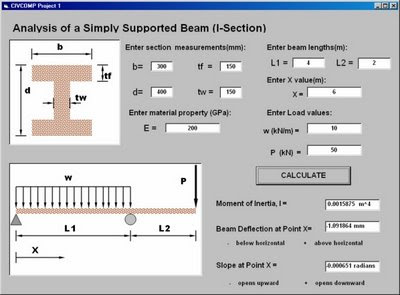
Innovative approaches in teaching can be introduced in the classroom using the computer. In the author’s laboratory class on Computer Methods in Civil Engineering, students develop simple computer software applications and computer-based games on topics related to civil engineering using Visual Basic. By creating their own software applications, the students demonstrate their creativity and integrate concepts, methods and skills in mathematics, basic engineering and specialized civil engineering subjects. These software applications and games can be introduced in the classroom to motivate learning and to facilitate retention and understanding of engineering concepts. Here are examples of the Graphical User's Interface of the students' projects.


Beam Deflection Application: This is a software application for solving the elastic deflection and slope of a beam. The inputs to the program are the cross-section dimension and properties of the I-section and the beam loadings and lengths. The outputs include the moment of inertia of the I-section, the beam deflection and slope at specified point X from the left end. This application may be used in the course on Mechanics of Materials or Structural Analysis to demonstrate the effect of section properties, beam loading and lengths on the elastic deflection and slope of a beam. By computing the deflection of the beam at different values of X, the shape of the elastic curve can be drawn.


Open Channel Flow: This software application determines the normal depth of an open channel using Manning’s Equation. In this program, the user first selects the shape of the cross-section: (a ) rectangle, (b) trapezoid, or (c) triangle. The system of units have to be chosen also. The inputs to the program are the dimensions of the cross-section and Manning equation parameters, S, n and Q. The output of the program is the normal depth of flow. This software application can be used in the courses, Fluid Mechanics or Hydraulics. The values of the various parameters, such as dimensions of the cross-section, slope of channel bed, coefficient of roughness or flow rate, maybe varied to study the effect on the normal depth of flow.

You may download and try these programs at my website at http://mysite.dlsu.edu.ph/faculty/oretaa.