Showing posts with label Earthquakes and Disasters. Show all posts

Saturday, February 25, 2023

HERITAGE CONSERVATION ASSET VALUE RATING OF BUILDINGS IN A SCHOOL CAMPUS FOR DISASTER RISK ASSESSMENT - 8ACEE KEYNOTE LECTURE


Prof. Andres W.C. Oreta presented a keynote lecture on HERITAGE CONSERVATION ASSET VALUE RATING OF BUILDINGS IN A SCHOOL CAMPUS FOR DISASTER RISK ASSESSMENT co-authored with Corinne Wesnee D. Yu,  Carlyse Nicole L. Kah, Aldrei Charles C. Navera, Charles Janzen C. Sy and Rodolfo P. Mendoza, Jr. at the 8th ASIA Conference on Earthquake Engineering (8ACEE) held at Taipei, Taiwan on Nov. 9-11, 2022. 

ABSTRACT. A campus is an area occupied by the buildings of an educational facility, usually a university or college. A school campus, especially those located in hazard-prone regions, must be safe and resilient to various disasters like earthquake, wind or flood to protect the community of learners and teachers and to assure the continuous operation of the school. Hence, the existing buildings in a campus must be assessed to determine if immediate repair or retrofitting is necessary. Structural assessment and retrofitting is costly and time consuming, though, especially if there is a large population of school buildings in a campus. Hence, a rapid assessment that is not expensive and easy to implement must be conducted first before any detailed inspection and retrofitting be implemented. To prioritize which buildings need immediate detailed inspection, risk assessment using a disaster risk reduction and management (DRRM) framework may be used. The disaster risk assessment framework involves the interaction of hazard, vulnerability, and asset. At the center of disaster risk assessment is the “Asset” which has an associated value that depends on the importance and function of the building. In this study, the value of a school building is viewed with a heritage conservation perspective. A simple and qualitative asset value rating of existing buildings in a campus considering educational function and the building’s architecture and  history is presented. The asset value rating can then be integrated to the DRRM framework for the overall risk assessment of existing buildings in a campus. A case study of the qualitative asset value rating and seismic risk assessment of De La Salle University campus in Manila, Philippines is presented. In the case study, two important buildings with significant heritage value to the university were identified.


Friday, January 15, 2021

A BRIEF CODE-BASED SEISMIC DIAGNOSTIC TOOL FOR EXISTING RC BUILDINGS - Philippines

 A brief seismic diagnostic tool (BSDT) that is localized and based on the National Structural Code of the Philippines (NSCP) is developed as a tool for rapid visual screening of existing reinforced concrete buildings in the Philippines. A BSDT that uses seismic code parameters from the NSCP would be easier to use for local evaluators since local civil engineers are familiar with the NSCP parameters.  Vertical irregularities are also known to contribute to the vulnerability of buildings when subjected to ground motion. This study will also present push-over analysis simulations of buildings with vertical irregularities specifically (1) Vertical Geometric Irregularity, (2) Soft Story, and (3) Mass Irregularity. Vertical irregularity parameters are introduced in the simulations and these parameters are introduced to determine score modifiers for the assessment of vulnerability of buildings with vertical irregularities. The result of the study is a more refined qualitative/semi-quantitative brief seismic diagnosis tool for existing reinforced concrete buildings for the Philippines.

For more details: Oreta, A. and Dy, Adrian. "Development of a Brief Code-Based Seismic Diagnostic Tool for Existing RC Buildings Considering Vertical Irregularities,” International Conference in Commemoration of 20th Anniversary of the 1999 Chi-Chi Earthquake at Taipei, Taiwan held on September 15-19, 2019.

Read the paper at SCRIBD. 

Brief Code-Based Seismic Di... by Andy Oreta

Saturday, April 13, 2019

Seminar on Disaster Risk Reduction and Infrastructure Development


CIV680 is a graduate seminar on Disaster Risk Reduction and Infrastructure Development (DRRID) in the graduate program for Civil Engineering. The course presents the impact of natural hazards on the built environment and explores ways of reducing the adverse effects of the natural hazards and improving infrastructure and community resilience. The topics that are discussed include disaster and development, natural hazards (earthquakes, volcanoes, wind, flood), risk, vulnerability, risk assessment, hazard analysis, disaster risk reduction (DRR), infrastructure resilience and climate change adaptation (CCA).  The primary objective of the course is "to develop champions and advocates for DRR, CCA and Disaster Resilience." The course aims to integrate civil engineering to the broader problem on DRR, CCA and Resilience Building.

I introduced this course in 2014. In this, I invited faculty members in the college to deliver lectures on specialized topics related to DRRID. This term 2 AY2018-2019, I wish to express my gratitude to the following faculty members:
  1. Dr. Lessandro Garciano - Wind Hazards 
  2. Dr. Renan Tanhueco - Flood Hazards and Land Use Planning
  3. Dr. Mario De Leon - Tsunami, Storm Surge and Coastal Communities
  4. Dr. Jonathan Dungca - Geotechnical Hazards 
  5. Dr. Maricel Paringit - GIS and Mapping in DRRM
  6. Dr. Jojo Mutuc - System Dynamics and DRR
The culminating activity of the course is the DRRID Graduate Forum held last April 6, 2019 at DLSU Velasco Hall from 1:00 PM - 6:30 PM. In this activity, each student presents his/her seminar paper related to the theme of the course. 

The guest speaker in the forum was Dr. Emmanuel Luna, Professor in Community Development at UP Diliman and a director of the UP Resilience Institute. His presentation was on "Recovery of Infrastructures from Disasters: Lessons from Philippine Cases."
Dr. Luna presents his lecture  on Recovery of Infrastructures from Disasters: Lessons from Philippine Cases
The DRRID2019 Forum followed the program below:

Session 1 Opening Program - Emcee: Engr. Robert R. Dancel 
  •       Opening Prayer       – Engr. Angelica P. Saludo
  •       Welcome Message   – Dr. Andres Oreta (Professor, DLSU)
  •       Keynote Speech: Recovery of Infrastructures from Disasters: Lessons from Philippine Cases - Dr. Emmanuel M. Luna (Prof, UP Resilience Institute)

Session 2 DRRID Session 1 – Session Chair: Engr. Jon Arnel Telan
  • P1: Guidelines for Development of Contingency Plan for Stranded Workers During Sudden Urban Disaster - Revin Berces
  • P2: 3D Printed House for Disaster Affected Areas - Robert R. Dancel
  • P3: Evaluating the site suitability of evacuation centers against natural hazards using GIS - Aujhen De Torres
  • P4: Seismic Risk Assessment of Metro Manila Bridges  - Eden S. Ditchella
  • P5: Fire Risk And Hazard Assessment Of Heritage Building: Case Of University Of Santo Tomas, Main Building - John Emmanuel C. Endaya
Session 3 DRRID Session 2 – Session Chair: Engr. Aujhen De Torres
  •  P6: Assessment of Disaster Awareness & Preparedness of Selected Barangays in San Juan City - Marc Daniel D. Laurina
  •  P7: Seismic Risk Assesment of Military Facilities: Case study of Fort Magsaysay - Albert Pamonag
  •  P8: Earthquake Vulnerability Assessment of Medical Facilities Inside the University of Santo Tomas Campus - Angelica P. Saludo
  • P9: Hazard Identification and Risk Assessment of Century Old Churches in Pampanga - Rejoice Marie P. Sambo
  • P10: Liquefaction Potential Assessment of Areas near Specific Creeks in Manila - Jon Arnel S. Telan 


Robert Dancel, PhD student and the chair of the forum presents a certificate of appreciation to Dr. Luna

The DRRID2019 Forum pamphlet with the abstracts of the seminar papers
 A best presentation was selected by Dr. Luna and Engr. Jon Arnel Telan was the selected the best presentor.

Wednesday, April 22, 2015

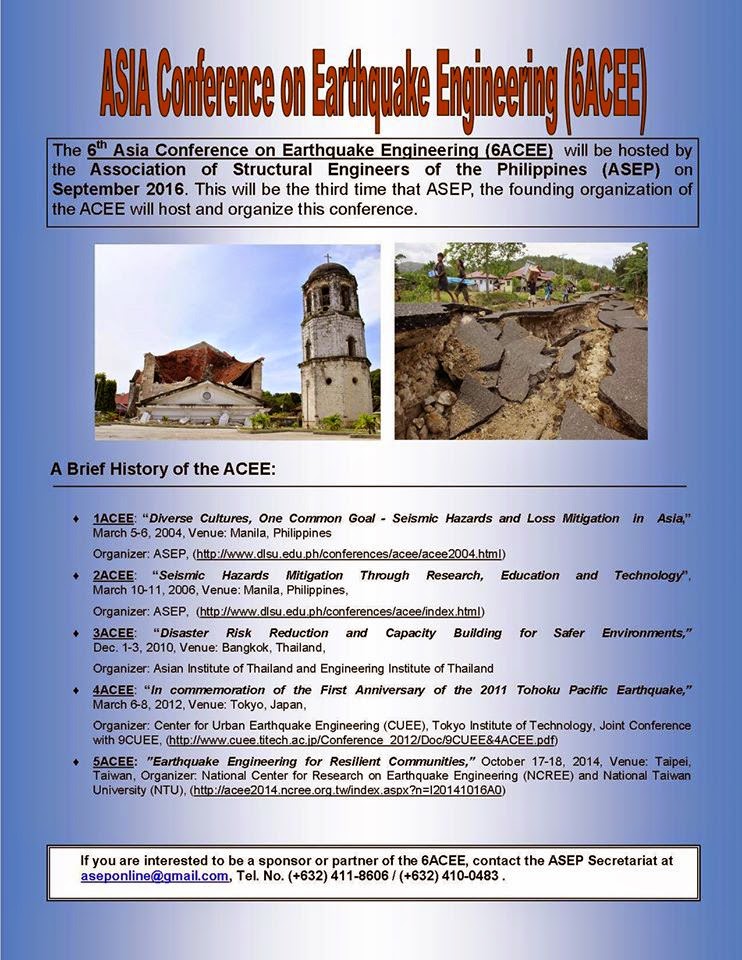
A Call for Support - The 6th ASIA Conference on Earthquake Engineering (6ACEE 2016- Cebu City, Philippines)


The 6ACEE returns to the Philippines and will again be hosted by ASEP on  September 22-24, 2016 on the occasion of its anniversary and the 3rd anniversary of the 2013 Bohol Earthquake. The orgainizers plan to hold the 6ACEE at a venue in Cebu City. The theme of the 6ACEE is "Bridging Theory and Practice in Earthquake Engineering for Enhancing Community Resilience."


The ASIA Conference on Earthquake Engineering (ACEE) was founded in 2004 during the term of Engr. Rannie Ison as ASEP President and Cesar Pabalan as VP & conference  chair. My DLSU Co-faculty, Joseph Manalo, being the ASEP director and technical committee chair then discussed with me possible themes for the conference. I suggested a thematic international conference where we will invite international experts and professors as members of the scientific committee. We decided the theme on Earthquake Engineering and I quickly emailed my contacts in Japan and other countries such as Prof. Kazuhiko Kawashima (TIT), Prof. Fumio Yamazaki (Chiba U), Prof. Tadaaki Tanabe (Nagoya U), Prof. Panitan (Chula U), Prof. Penung (AIT), Dr. Solidum (PHIVOLCS), Dr, Pacheco (Vibrametrics) and  Prof. Pan (NUS)  for them to be members. Dr. Pacheco suggested many contacts to be members of the international advisor committee. Their favorable responses led to the birth of  the ACEE in 2004. A brief history of the ACCE is summarized below:

  • 1ACEE: “Diverse Cultures, One Common Goal - Seismic Hazards and Loss Mitigation  in  Asia,” March 5-6, 2004, Venue: Manila, Philippines, Organizer: ASEP, (http://www.dlsu.edu.ph/conferences/acee/acee2004.html)
  • 2ACEE: “Seismic Hazards Mitigation Through Research, Education and Technology”, March 10-11, 2006, Venue: Manila, Philippines, Organizer: ASEP,  (http://www.dlsu.edu.ph/conferences/acee/index.html)
  • 3ACEE: “Disaster Risk Reduction and Capacity Building for Safer Environments,” Dec. 1-3, 2010, Venue: Bangkok, Thailand,Organizer: Asian Institute of Thailand and Engineering Institute of Thailand
  • 4ACEE: “In commemoration of the First Anniversary of the 2011 Tohoku Pacific Earthquake,” March 6-8, 2012, Venue: Tokyo, Japan,Organizer: Center for Urban Earthquake Engineering (CUEE), Tokyo Institute of Technology, Joint Conference with 9CUEE, (http://www.cuee.titech.ac.jp/Conference_2012/Doc/9CUEE&4ACEE.pdf)
  •  5ACEE: ”Earthquake Engineering for Resilient Communities,” October 17-18, 2014, Venue: Taipei, Taiwan, Organizer: National Center for Research on Earthquake Engineering (NCREE) and National Taiwan University (NTU), (http://acee2014.ncree.org.tw/index.aspx?n=I20141016A0)
 
Strategies on how to increase the participation of interested stakeholders from various Asian countries- civil engineers, structural engineers, seismologist, DRRM experts and advocates - must be explored. One suggestion is to involve the various professional organizations interested in earthquake engineering from the various Asian countries to be supporting organizations of the 6ACEE. Hence, we call on these organizations such as the Japan Association on Earthquake Engineering (JAEE), Engineering Institute of Thailand and the professional organizations from Indonesia, Malaysia, Singapore, India, Taiwan, China, Korea and even Australia and New Zealand to support the 6ACEE.

Monday, October 21, 2013

Addressing Safety & Sustainability of Infrastructures in Hazard-Prone Countries

Keynote Paper delivered at Nagoya University's
International Forum on CE Infrastructure Technology Transfer, 31 August 2013
 Abstract
“Civil Engineers shall hold paramount the safety, health and welfare of the public and shall strive to comply with the principles of sustainable development in the performance of their duties.” This is one of the fundamental canons of the Code of Ethics of Civil Engineers. The task of a civil engineer includes provision of safe, reliable and comfortable infrastructures for housing, transport, communication, water supply and sanitation, energy, commercial and industrial activities to meet the needs of a growing population. Today, there is an increasing demand for civil engineers to focus their efforts on the protection and preservation of the environment. With the increase in severity and frequency of natural disasters that devastated both developing and advanced countries,  planning, design and construction of infrastructures that are safe for people and at the same time reduce their impact on further deterioration of the environment becomes a major challenge. Civil engineers who are experts in the various fields of specialization in structural engineering, transportation engineering, water resources engineering, geotechnical engineering and construction engineering must embed in their tasks disaster risk reduction especially in hazard-prone regions – for when they do this, they not only address safety but also sustainability – two important issues for maintaining the balance and harmony between the built and natural environment.
Living in hazard-prone regions. Achieving safety and sustainability is a major challenge in regions or countries that are vulnerable to adverse natural hazards like earthquakes, typhoons, floods, volcanic eruptions, drought and tsunamis. The vulnerabilities of the built environment to a hazard depend on the safety provided and sustainability features. The disaster will have impacts on both the built and natural environment.

READ THE FULL PAPER

Thursday, August 30, 2012

What is a soft story?

One of the requirements in my undergraduate course (STEQUAK) at DLSU is a group research related to earthquake engineering. The group has to present their topic orally using multimedia - powerpoint slides and a short video. The group of Gian Panaligan, Jerome Sy, Jospeh Oropel and Janelle Ong created a video about their topic, "How can we improve the seismic performance of a building with a soft story?" The language used is Filipino and their acting is very natural. A good story about a "soft story." Watch and enjoy.


Our last meeting - STEQUAK (Earthquake Engg) Class
8/30/2012

Wednesday, August 4, 2010

Advocacy Guide for the Campaign for Safe Schools and Hospitals


“Awareness is the first step towards action” . This is the main rationale for the One Million Safe Schools and Hospitals Advocacy Guide. This primer aims to raise the awareness of the primary stakeholders of schools and hospitals - the young children, teachers, parents, medical doctors, nurses, technicians, administrators, government and the public on the urgency of making schools and hospitals safer especially in hazard-prone regions. The guide presents in simple terms the concepts of safety, hazard, vulnerability and risk and provides the reader key questions for self assessment and reflection regarding the safety conditions of his/her school or hospital. Once the need for safer schools and hospitals is appreciated, the reader will be motivated to make a pledge in the One Million Safe Schools and Hospitals Campaign to create a demand to make our schools and hospitals safer.


Read the One Million Safe Schools and Hospitals Advocacy Guide and learn more on how you can contribute in making schools and hosptials safer. Visit the campaign website at http://safe-schools-hospitals.net/.

Monday, July 19, 2010

Seismic Conceptual Design of Buildings

Here is a useful slide presentation on Basic Principles on Seismic Design which can be downloaded from www.slideshare.net.

Thursday, April 15, 2010

Are our schools and hospitals SAFE?


*SAFETY FIRST: Are our schools and hospitals safe? What can be done to make schools and hospitals safer?

Safety is a human concern – this concern must be taken more decisively by school and hospital communities given that they are in the business of caring for the young and in preserving lives. It is a concern that must be taken seriously and strive continually to achieve at all times especially during emergencies. A school or hospital and the highly vulnerable occupants – the children and the sick - are best protected by ensuring that the physical environment – the buildings, surroundings and facilities are safe, and secured by implementing regular maintenance of physical facilities and by preparing a systematic and well-documented safety and disaster preparedness plan.

Safety Check: Are the basic conditions and necessities in place in your school or hospital to provide for the health, security and safety of the occupants? Take a walk around your school campus or health facility and observe the items listed in the checklist. After this brief safety check, ask yourself the following questions: Is my school or hospital safe? What policies and actions should be done to improve the safety conditions in my school or hospital?

A Sample Checklist on Basic Safety Requirements

  • Is water suitable for food preparation and drinking available?
  • Is water suitable for personal hygiene and cleaning available?
  • Is adequate lighting in all areas of the building and surroundings provided?
  • Is a manual fire alarm system in place?
  • Are fire extinguishers found in corridors, exit routes and high risk rooms?
  • Are floors clean, non-slippery, without splinters and holes?
  • Is there access for the disabled?
  • Are corridors are wide and spacious, free from obstructions especially during an emergency?
  • Are roofing materials completely and securely fastened and leak proof?
  • Can room doors be opened from the inside for emergency exit purposes?
  • Are stairways safe with adequate secured railings?
  • Are electrical wires and cables properly fastened and secured?
  • Are doors securely attached to jambs?
  • Are entrance and exit points secured?
  • Are proper exit markings provided to assist people that are not familiar where exits/ emergency exits are located?
  • Are combustible and hazardous chemicals and gases safely and appropriately located?
  • Are functional electrical and emergency lights with battery back-up in all critical areas available especially in hospitals?
  • Are regular emergency drills (e.g. fire, earthquake drills) conducted?
  • Are emergency evacuation maps posted in critical areas?
  • Are periodic inspection, repair and maintenance of facilities and surroundings done?

If your answer to any of the questions is NO, then you must be concerned with the safety of your school or hospital. Providing the basic safety features in schools and hospitals is actually not enough to protect people and property especially in a hazard-prone environment. Hazards such as earthquakes, floods, fires, typhoons, landslides, etc. pose greater risks to schools or hospitals if interventions are not done to limit and/or mitigate the vulnerability to these hazards.

You can make schools and hospitals safer esepcially before a disaster strikes by acting now. The first step is visit the website of the One Million Safe Schools and Hospitals Campaign at http://www.safe-schools-hospitals.net/ and make a pledge.. You can pledge in any of the following roles:

  • As an advocate for safe schools and hospitals
  • As a leader for emergency and disaster preparedness
  • As a champion for disaster risk reduction

Make a pledge, Save a Life!

The life that you may save maybe your loved ones or yours.

* Reference: 1 Million Safe Schools and Hospitals ADVOCACY Guide by UNISDR 2010

Sunday, November 8, 2009

Scholarships for future Earthquake Engineers & Seismologists

When I was a visiting scientist at the Tokyo Institute of Technology, Japan, I remember my host Prof. Kazuhiko Kawashima telling me about ROSE School - The Centre for Post-Graduate Training and Research in Earthquake Engineering and Engineering Seismology . It was my first time to hear about it. He was a visiting professor at ROSE School and he taught Seismic Design of Highway Bridges. I browsed the website and was impressed by the school's programs like the MEEES Programme which aims to provide higher-level education in the field of Earthquake Engineering and Engineering Seismology. I received an email from a colleague about Scholarships in Earthquake Engineering and Seismology. ROSE school seems to be the lead university in the scholarships. The Philippines is an earthquake country and needs specialists in this field. I hope our graduates - engineers and scientists - will grab this opportunity.

SCHOLARSHIPS FOR MASTERS IN EARTHQUAKE ENGINEERING AND/OR ENGINEERING SEISMOLOGY

Applications for the Masters in Earthquake Engineering and/or Engineering Seismology (MEEES), approved and financially supported by the European Commission under the framework of the Erasmus Mundus II programme, have just opened, with a deadline of 31st of December 2009.

The Masters is organised by a consortium of European University/Research Institutions, led by the Centre for Post-Graduate Training and Research in Earthquake Engineering and Engineering Seismology (ROSE School, www.roseschool.it) and featuring also the participation of the University of Patras (Greece), the University of Grenoble Joseph Fourier (France) and the Middle East Technical University of Ankara (Turkey).

The MEEES programme is an Erasmus Mundus Masters Course, that aims to provide higher-level education in the field of Earthquake Engineering and Engineering Seismology. Graduate students involved in this Erasmus Mundus Masters course have the possibility of following a 18-month MSc programmes on either Earthquake Engineering or Engineering Seismology. In addition, the proposed EM Masters course envisages also the possibility of students following a 18-month study programme that leads to the attainment of a Masters degree on Earthquake Engineering and Engineering Seismology.

A relatively large number of scholarships, ranging from 15000 to 38000 Euro, are available to applicants from all nationalities.

Full details on the programme, as well as online application procedure, can be found on its website:
http://www.meees.org/

Thursday, June 4, 2009

Play BEAT THE QUAKE

What precautions should you do to protect people from harm and reduce damages to property in case an earthquake occurs? Test your knowledge on earthquake preparedness and safety by visiting http://www.dropcoverholdon.org/ and play "Beat the Quake." In this game, you are challenged to make your home a safe place during an earthquake. You click on each object shown in the room and you choose an option on how to secure it. But you must hurry, because the earthquake may happen any time. After the quake, you will see how the objects responded to your design. This is both fun and educational especially to kids. Are you ready to play "Beat the Quake"?

Thursday, January 22, 2009

Tales of Disasters: Earthquake!

Here is another film made by No Strings for programmes in South East Asia and funded by Trocaire. The movie is about Badu and the Little Girl who experienced an earthquake. It is a movie on earthquake preparedness and response. Watch this with your kids.

This video was accessed at http://cogssdpe.ning.com/.

Friday, January 9, 2009

Tales of Disasters: Tsunami!

I joined a social network - Coalition for Global School Safety & Disaster Prevention Education and learned of the various initiatives around the world in promoting disaster awareness to the public especailly in schools through the world wide web. I found interesting videos created by No Strings, a group of puppeteers who use colorful and engaging adventure films to teach life-saving messages to children.
Here is the first video on Tsunami. The story centers on Badu, a likeable but lazy villager who teaches by negative example and a Little Girl who is aware of natural hazards and disasters and their signs and effects. Watch this video with your kids as this is really very informative.

Thursday, December 4, 2008

Structural Engineering for Kids 4 - Building Up London Bridge

London Bridge is a nursery rhyme where various concepts in structural engineering may be introduced. Obviously, the concept of structural engineering failures is described in this song - London Bridge is falling down. Structural failure this time is described in relation to different types of construction materials. The behavior and strength of various structural engineering materials and members can be described while playing the song - Build it up with pins and needles…Build it up with wood and clay…Build it up with iron and steel.. Build it up with stone so strong. How the structural members fail depends on the structural properties of the materials – brittle materials like concrete break or crush, ductile materials like iron and steel bend or yield. So London Bridge failed in various ways - Pins and needles bend and break…Wood and clay will wash away…Iron and steel will bend and bow… Stone so strong will last so long. Bridge failures, however, depend on many factors as shown in the video below like the structural design of the piers including the detailing of reinforcement, the bridge deck supports, the soil and foundation...

This nursery ryhme may also be a good opportunity to introduce the concept of strengthening and retrofitting of existing structures. So when London Bridge fell, the ryhme continues - We must build it up again, Up again, Up again. We should not wait for another bridge disaster to occur. We should learn form the previous bridge disasters like those that happened to the Tacoma Narrows Bridge in 1940 or the Hanshin Expressway in 1995. We should act now to strengthen and retrofit existing bridges and structures. The last slide in the video clip shows the bridge pier retrofitted against earthquake effects.

Tuesday, November 18, 2008

Structural Engineering for Kids 1- Humpty Dumpty & Structural Failures

Remember the nursery rhymes and songs your parents have read and sung for you just to put you to sleep? You or your parents may have not realized that when you were babies, you were unconsciously introduced to basic concepts of Structural Engineering whenever these nursery songs are played.
Humpty Dumpty sat on a wall
Humpty Dumpty had a great fall
All the king’s horses and
All the king’s men
Couldn’t put Humpty Dumpty
Together again
This nursery rhyme is a favorite of my two kids. It is a lesson on structural engineering failures and instability. The egg-shaped Humpty Dumpty is an example of an unstable structure. A little push will make it roll and fall. Similarly, buildings or bridges will be damaged or will collapse if they are not properly designed and built against expected forces. Proper design of foundations, detailed analysis of connections, and correct design of structural members are necessary ingredients against structural failures. Minor damages such as simple cracks may be acceptable but structures must not collapse, such that they are beyond repair endangering people's lives.

Inspired by the Humpty Dumpty music, I created a short video clip about the damaged buildings during the 1990 Luzon Earthquake. Humpty Dumpty here represents Luzon and its damaged structures. Perhaps, nursery rhymes and children songs may be a good way of introducing Disaster Awareness and Preparedness to kids.

The idea of this blog was inspired from Henry Petroski’s book, “To Engineer is Human.” Petroski argues that “the ideas of engineering are in our bones and part of our human nature and experience.” This is a good book specially for non-technical people who wants to understand concepts of engineering design.