Showing posts with label conference. Show all posts

Saturday, February 25, 2023

HERITAGE CONSERVATION ASSET VALUE RATING OF BUILDINGS IN A SCHOOL CAMPUS FOR DISASTER RISK ASSESSMENT - 8ACEE KEYNOTE LECTURE


Prof. Andres W.C. Oreta presented a keynote lecture on HERITAGE CONSERVATION ASSET VALUE RATING OF BUILDINGS IN A SCHOOL CAMPUS FOR DISASTER RISK ASSESSMENT co-authored with Corinne Wesnee D. Yu,  Carlyse Nicole L. Kah, Aldrei Charles C. Navera, Charles Janzen C. Sy and Rodolfo P. Mendoza, Jr. at the 8th ASIA Conference on Earthquake Engineering (8ACEE) held at Taipei, Taiwan on Nov. 9-11, 2022. 

ABSTRACT. A campus is an area occupied by the buildings of an educational facility, usually a university or college. A school campus, especially those located in hazard-prone regions, must be safe and resilient to various disasters like earthquake, wind or flood to protect the community of learners and teachers and to assure the continuous operation of the school. Hence, the existing buildings in a campus must be assessed to determine if immediate repair or retrofitting is necessary. Structural assessment and retrofitting is costly and time consuming, though, especially if there is a large population of school buildings in a campus. Hence, a rapid assessment that is not expensive and easy to implement must be conducted first before any detailed inspection and retrofitting be implemented. To prioritize which buildings need immediate detailed inspection, risk assessment using a disaster risk reduction and management (DRRM) framework may be used. The disaster risk assessment framework involves the interaction of hazard, vulnerability, and asset. At the center of disaster risk assessment is the “Asset” which has an associated value that depends on the importance and function of the building. In this study, the value of a school building is viewed with a heritage conservation perspective. A simple and qualitative asset value rating of existing buildings in a campus considering educational function and the building’s architecture and  history is presented. The asset value rating can then be integrated to the DRRM framework for the overall risk assessment of existing buildings in a campus. A case study of the qualitative asset value rating and seismic risk assessment of De La Salle University campus in Manila, Philippines is presented. In the case study, two important buildings with significant heritage value to the university were identified.


Sunday, July 8, 2018

Marathon Presentation at the PICE Midyear Technical Conference 2018

Presenting to about 9,000 Filipino civil engineers was awesome. But presenting the same presentation three times was a marathon experience!

In the Philippine Institute of Civil Engineers (PICE) Midyear Regional Technical Conference (RTC) held at Iloilo City last June 13-14, 2018 I and my co-presentor, Engr. Kirk Yu delivered a lecture on the topic, "Structural Engineering and Heritage Preservation." I presented the basic definitions on heritage conservation, the impact of disasters on heritage structures and the role of civil engineers in heritage preservation. Kirk Yu presented our research on multi-hazard risk assessment of heritage buildings in Iloilo City CBD and examples of NDT and semi-destructive testing for determining material properties of heritage structures.

The registered participants to the RTC was about 9,000 but the capacity of the new Iloilo Convention Center (ICC) is 6,000. So what the organizers did was to have three venues for the RTC: venue 1 at ICC (6,000 capacity), venue 2 at Central Philippine University auditorium (2,000 capacity) and venue 3 at Diversion 21 Hotel (1,000 capacity). So the lecturers have to deliver the same presentation at the three venues at different times and day. It was an awesome and tiring experience!

What is the impact of earthquakes on heritage? I asked the audience.
The audience (6,000 strong) at Iloilo Convention Center
Part of my lecture was a tribute to the late Architect Augusto Villalon - a champion in heritage conservation

At venue 2 - Central Philippine University

The 2,000 participants at CPU Auditorium
With former Dean Walden Rio of CPU and Kirk Yu
 
The participants at venue 3 - Diversion 21 Hotel
Receiving the token of appreciation after the lecture at ICC

Wednesday, April 22, 2015

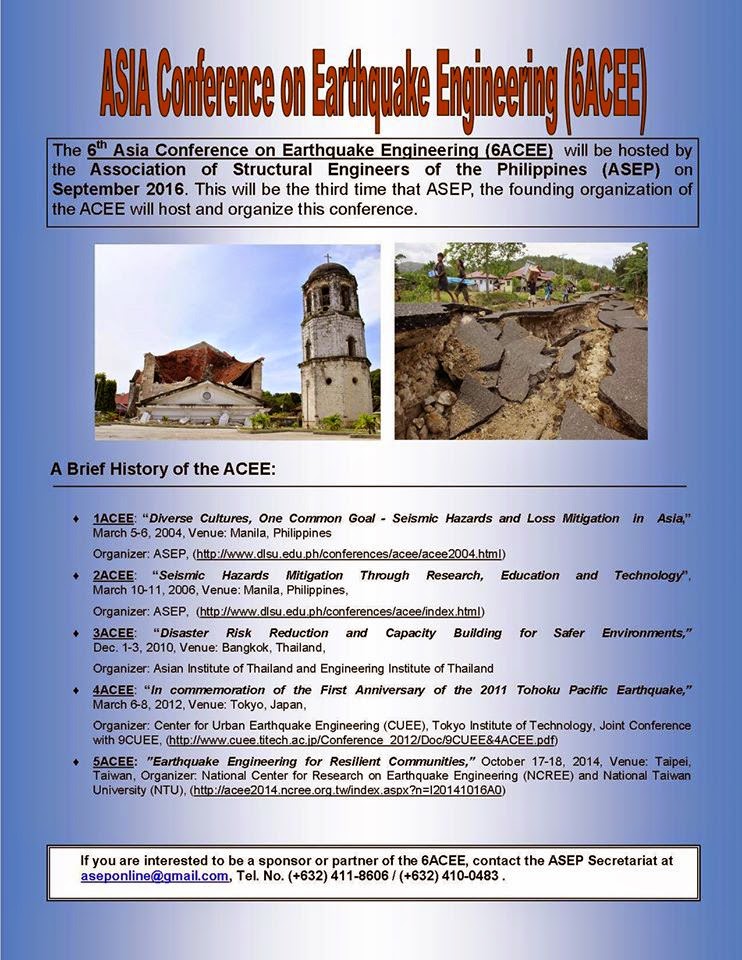
A Call for Support - The 6th ASIA Conference on Earthquake Engineering (6ACEE 2016- Cebu City, Philippines)


The 6ACEE returns to the Philippines and will again be hosted by ASEP on  September 22-24, 2016 on the occasion of its anniversary and the 3rd anniversary of the 2013 Bohol Earthquake. The orgainizers plan to hold the 6ACEE at a venue in Cebu City. The theme of the 6ACEE is "Bridging Theory and Practice in Earthquake Engineering for Enhancing Community Resilience."


The ASIA Conference on Earthquake Engineering (ACEE) was founded in 2004 during the term of Engr. Rannie Ison as ASEP President and Cesar Pabalan as VP & conference  chair. My DLSU Co-faculty, Joseph Manalo, being the ASEP director and technical committee chair then discussed with me possible themes for the conference. I suggested a thematic international conference where we will invite international experts and professors as members of the scientific committee. We decided the theme on Earthquake Engineering and I quickly emailed my contacts in Japan and other countries such as Prof. Kazuhiko Kawashima (TIT), Prof. Fumio Yamazaki (Chiba U), Prof. Tadaaki Tanabe (Nagoya U), Prof. Panitan (Chula U), Prof. Penung (AIT), Dr. Solidum (PHIVOLCS), Dr, Pacheco (Vibrametrics) and  Prof. Pan (NUS)  for them to be members. Dr. Pacheco suggested many contacts to be members of the international advisor committee. Their favorable responses led to the birth of  the ACEE in 2004. A brief history of the ACCE is summarized below:

  • 1ACEE: “Diverse Cultures, One Common Goal - Seismic Hazards and Loss Mitigation  in  Asia,” March 5-6, 2004, Venue: Manila, Philippines, Organizer: ASEP, (http://www.dlsu.edu.ph/conferences/acee/acee2004.html)
  • 2ACEE: “Seismic Hazards Mitigation Through Research, Education and Technology”, March 10-11, 2006, Venue: Manila, Philippines, Organizer: ASEP,  (http://www.dlsu.edu.ph/conferences/acee/index.html)
  • 3ACEE: “Disaster Risk Reduction and Capacity Building for Safer Environments,” Dec. 1-3, 2010, Venue: Bangkok, Thailand,Organizer: Asian Institute of Thailand and Engineering Institute of Thailand
  • 4ACEE: “In commemoration of the First Anniversary of the 2011 Tohoku Pacific Earthquake,” March 6-8, 2012, Venue: Tokyo, Japan,Organizer: Center for Urban Earthquake Engineering (CUEE), Tokyo Institute of Technology, Joint Conference with 9CUEE, (http://www.cuee.titech.ac.jp/Conference_2012/Doc/9CUEE&4ACEE.pdf)
  •  5ACEE: ”Earthquake Engineering for Resilient Communities,” October 17-18, 2014, Venue: Taipei, Taiwan, Organizer: National Center for Research on Earthquake Engineering (NCREE) and National Taiwan University (NTU), (http://acee2014.ncree.org.tw/index.aspx?n=I20141016A0)
 
Strategies on how to increase the participation of interested stakeholders from various Asian countries- civil engineers, structural engineers, seismologist, DRRM experts and advocates - must be explored. One suggestion is to involve the various professional organizations interested in earthquake engineering from the various Asian countries to be supporting organizations of the 6ACEE. Hence, we call on these organizations such as the Japan Association on Earthquake Engineering (JAEE), Engineering Institute of Thailand and the professional organizations from Indonesia, Malaysia, Singapore, India, Taiwan, China, Korea and even Australia and New Zealand to support the 6ACEE.

Monday, October 21, 2013

Addressing Safety & Sustainability of Infrastructures in Hazard-Prone Countries

Keynote Paper delivered at Nagoya University's
International Forum on CE Infrastructure Technology Transfer, 31 August 2013
 Abstract
“Civil Engineers shall hold paramount the safety, health and welfare of the public and shall strive to comply with the principles of sustainable development in the performance of their duties.” This is one of the fundamental canons of the Code of Ethics of Civil Engineers. The task of a civil engineer includes provision of safe, reliable and comfortable infrastructures for housing, transport, communication, water supply and sanitation, energy, commercial and industrial activities to meet the needs of a growing population. Today, there is an increasing demand for civil engineers to focus their efforts on the protection and preservation of the environment. With the increase in severity and frequency of natural disasters that devastated both developing and advanced countries,  planning, design and construction of infrastructures that are safe for people and at the same time reduce their impact on further deterioration of the environment becomes a major challenge. Civil engineers who are experts in the various fields of specialization in structural engineering, transportation engineering, water resources engineering, geotechnical engineering and construction engineering must embed in their tasks disaster risk reduction especially in hazard-prone regions – for when they do this, they not only address safety but also sustainability – two important issues for maintaining the balance and harmony between the built and natural environment.
Living in hazard-prone regions. Achieving safety and sustainability is a major challenge in regions or countries that are vulnerable to adverse natural hazards like earthquakes, typhoons, floods, volcanic eruptions, drought and tsunamis. The vulnerabilities of the built environment to a hazard depend on the safety provided and sustainability features. The disaster will have impacts on both the built and natural environment.

READ THE FULL PAPER

Sunday, June 9, 2013

Greener Designs of Buildings using the Structural Sustainability Index

Sustainability is a concern that must also be addressed by structural engineers. Structural engineers must be able to discriminate as to which materials and processes would have a lesser impact to the environment, and to coordinate with the other stakeholders of the structure. The concept of the study is to enable the structural engineer to analyse the sustainability of structural systems in a quantifiable manner. 

In designing a house, or any structure, there are three things commonly considered by the structural engineer. Namely: safety, serviceability and cost. Safety and serviceability ensure that the structure can fulfill its intended purpose by satisfying code requirements on strength, ductility and deflections. Addressing economy, on the other hand, requires value engineering to produce an optimum design with reasonable cost. There is now an increasing concern about the environmental impact of structures. Sustainable design of houses must be pursued to address this concern. But what parameter may be used to guide structural designers to make their structures “greener”?

In an undergraduate thesis, the environmental impact of the structural systems and envelope of selected housing units for a middle class family in the Philippines using Life Cycle Analysis (LCA) was conducted.  The five environmental impact parameters: (a) Global Warming Potential, (b) Ocean Acidification, (c) Abiotic Material Depletion, (d) Energy Use, (e) Human Toxicity were assessed considering the manufacturing and disposal stage as the system boundary in the LCA study. A  “Structural Sustainability Index” or SSI which produces a single score aggregating the five impacts was derived by assigning weights based on an expert’s survey for each environmental impact indicator. The SSI can be used for ranking houses based on environmental impact and can be used as a parameter to guide structural engineers in comparing various design alternatives and selecting  “greener designs”.

The image below is a poster submitted to the ASEP Student Research Competition during the 16th ASEP International Conference held on May 23-25, 2013.


Friday, January 16, 2009

ASEP 14th International Convention - Call for Abstracts

The Association of Structural Engineers of the Philippines, Inc. (ASEP) on its 47th year is hosting the 14th ASEP International Convention with the theme, “Structural Engineering: Coping with the Global Crisis” on May 21-22, 2009. In this regard, you are invited to submit an abstract and full paper (later) for presentation during the convention.
Topics of papers on structural engineering which address innovative approaches of coping with the global crisis and problems - financial, political, environmental, climate change, natural disasters, terrorism, poverty and sustainability - are welcome.
Specific topics include: Performanced-based design, Retrofitting and Strengthening, Structural Failures, Structural Risk, Natural Hazards and Disaster Rsis Mitigation, ISO Standards and Codes of Practice, Earthquake and Wind Engineering, Value Engineering, Engineering Ethics, Urban Planning and Infrastructure Development, Fire, Impact and Blast Loads, Case Studies on High-Rise Buildings and Long-Span Bridges, Prestresses and Pre-cast Construction, Foundation and Geotechnical Issues.

Deadline of Submission of Abstracts: 14 February 2009
Deadline of Submission of Full Papers: 24 March 2009

Send abstracts to: asep14aic@gmail.com